TRAVELS BOOKS INTERNET SHOWBIZ Archive Jan 24 Archive Jan 17 Archive Feb 14 Archive Feb 21 Archive Dec 13

An independent view of the world seen from Pacific Tokelau

The Independent New York Times

Pacific, June, 2010 - News Magazine's Summary of News - Editor - sumpinein@gmail.com

CHINESE WORKERS DEMAND GREATER SHARE OF WEALTH

(Reuters) - The labour unrest that began among foreign firms in south China's Pearl Delta area is showing signs of spreading to poorer interior regions, as a new generation of workers seek a bigger portion of the nation's growing wealth. The burst of reported strikes is a worry for China's ruling Communist Party, which has long discouraged independent worker action and punished protesters. While Beijing has made vows of better incomes for workers and farmers a cornerstone of policy, local officials are often focused on attracting investors with cheap, trouble-free labour to fuel China's export boom. Following recent high-profile disputes at Honda Motor and iPhone maker Foxconn International, strikes were reported at a Taiwanese-owned sports goods supplier in Jiangxi province, and at Japanese sewing machine maker Brother Industries in Xian -- both some distance from China's wealthier regions near Hong Kong and Shanghai. "All it takes now is a single spark and news will spread all over China, which could lead to similar industrial action in other factories," said Paul Tang, chief economist at Bank of East Asia in Hong Kong. Reports of the poor working conditions first began to surface last month when Chinese and later foreign media began detailing a string of suicides at a massive south China compound run by Foxconn, a unit of Taiwan electronics giant Hon Hai. Subsequent outbreaks of labour unrest have not been as widely reported in local media, possibly reflecting official reluctance to spread word of the disputes.

...........READ THE PRISM...........READ THE PRISM..........

CAMERON & AUSTERITY AS PARIS AND BERLIN BICKER... EX-TRADER GOES ON TRIAL
LONDON — Prime Minister David Cameron said that Britain’s financial situation was “even worse than we thought” and that savage spending cuts were needed to bring the deficit under control. Stern and grim-faced Mr. Cameron said, “The decisions we make will affect every single person in our country,” he said. “And the effects of those decisions will stay with us for years, perhaps decades, to come.” BRUSSELS — A deal was struck Monday to establish a 440 billion-euro safety net for debt-laden countries in the euro zone, a move that officials hope will calm the markets that have helped prompt a slide in the value of the euro. For several weeks, there has been uncertainty about the technicalities of a large-scale rescue plan, worth a total of 750 billion euros, or $896 billion, announced on May 10 as the crisis over sovereign debt gathered pace. PARIS - Former trader Jerome Kerviel goes on trial Tuesday accused of unauthorised deals that cost French bank Societe Generale five billion euros. His lawyers will argue that he is the victim, not the culprit, in the huge trade, the unwinding of which rocked stock markets at the time. Kerviel, 33, is charged with abuse of trust, falsifying documents and hacking into bank computers.

IN THE MOOD FOR LOVE

CHINESE DRINK

OIL FLOW TO LAST MONTHS

Gulf of Mexico - The fight to cut off the flow of oil feeding the giant oil slick in the Gulf of Mexico could take three months, BP said today. The oil giant launched a new front in its battle to contain the spill, as engineers began drilling a relief well designed to cut off the leaking oil permanently. The new well, which is in 5,000 feet of water, is planned to intercept the existing well at 13,000 feet — about two miles — below the seabed. It will be used to inject cement to cap the one that is leaking. Drilling began on Sunday at 3pm local time, after days of delays caused by poor weather conditions. However, BP confirmed that the operation would take “some three months” to complete.

ANGLO IRISH BANK CHAIRMAN ARRESTED

Dublin - Irish police yesterday arrested Sean FitzPatrick, the former chairman of Anglo Irish Bank. Mr FitzPatrick, a high-profile emblem of Ireland’s Celtic Tiger boom years, is the first to have been arrested. The Irish Independent predicted that Anglo’s pre-tax loss for the 15 months to the end of December could be as high as €12 billion — more than Ireland collects in income tax annually. The regulator has also been investigating whether Anglo Irish used more than €7 billion of short-term deposits from Irish Life & Permanent to mask large customer deposit withdrawals.

VOTE FOR EXTINCTION

Qatar - Proposals to ban trade in bluefin tuna and polar bears were overwhelmingly rejected yesterday at the Convention on International Trade in Endangered Species (Cites), meeting in Doha, Qatar. Feelings were running high yesterday about the failure of measures to protect endangered tuna. Only 20 of the 120 countries at the meeting voted to ban trade in the bluefin. Intensive lobbying by Japan, which consumes 80 per cent of Atlantic and Mediterranean bluefin, meant that a snap vote was held before any debate on scientific reports that show a catastrophic decline in the largest of the tuna family.

ALICE IN WONDERLAND

New York Times Review - Tim Burton has done his best work with contemporary stories, so it’s curious if not curiouser that he’s turned his sights on another 19th-century tale. Perhaps after slitting all those throats in his adaptation of “Sweeney Todd,” he thought he would chop off a few heads. Whatever his inspiration, he has tackled this new story with his customary mix of torpor and frenzy. After a short glance back at Alice’s childhood and an equally brief look at her present, he sends the 19-year-old on her way, first down the hole and then into a dreamscape — unfortunately tricked out with 3-D that distracts more than it delights — where she meets a grinning cat and a lugubrious caterpillar, among other fantastical creatures. Dark and sometimes grim, this isn’t your great-grandmother’s Alice or that of Uncle Walt, who was disappointed with the 1951 Disney version of “Alice in Wonderland.” “Alice has no character,” said a writer who worked on that project. “She merely plays straight man to a cast of screwball comics.” Of course the character of Carroll’s original Alice is evident in each outrageous creation she dreams up in “Wonderland” and in the sequel, “Through the Looking-Glass,” which means that she’s a straight man to her own imagination. (She is Wonderland.) Here she mostly serves as a foil for the top biller Johnny Depp, who (yes, yes) plays the Mad Hatter, and Mr. Burton’s bright and leaden whimsies.

THE FINANCIAL CRISIS NOVEL

International critics acclaim this novel of the financial crisis, the story of Irish bankers and City financiers in the worst financial crisis since the crash of 1929. Contact our literary critic at sumpinein@gmail.com

PUU OO ERUPTS

Stunning video shots show the lava has reached just behind the rim in one section, coinciding with Volcano Awareness Month in Hawaii.

COMMENT

A sign of the times. A modern folly or vision? The world's tallest building built on petro-dollars and speculation.

EDITORIAL

The leaders of 192 countries met under the aegis of the United Nations to come to an agreement to combat climate change. Whether we are believers or not this meeting has shown the incapacity of world leaders to come to a meaningful agreement and the futility of such conferences in the face of individual nations own priorities. The USA and China, the world's leading emitters of CO2, whilst showing they are the two most powerful nations on the planet, ignored the rest of the world. At the same time China showed its true face, arrogant and easily offended. What is evident to every human being is that our world is becoming more and more polluted with each passing day and our leaders...and scientists are incapable of finding a common ground to save us from the fate we are preparing for future generations.

SOME AVOIDED BEING TAKEN TO THE CLEANERS

NEW BOOKS

EAT YOUR DOG!

Owners should consider doing without, downsizing or even eating their pets to help save the planet. A medium-sized dog has the same impact as a Toyota Land Cruiser driven 6,000 miles a year, while a cat is equivalent to a Volkswagen Golf. But rabbits and chickens are eco-friendly because they provide meat for their owners while a canary or a goldfish has little effect on the environment. At the same time a pair of hamsters do the same damage as running a plasma television, suggests the book Time to Eat the Dog: The Real Guide to Sustainable Living. New Zealand-based authors Robert and Brenda Vale base their findings on the amount of land needed to grow food for pets ranging from budgerigars to cats and dogs. They say an average Collie eats 164kg of meat and 95kg of cereals a year, giving it a high impact on the planet. But a pair of rabbits can produce 36 young annually, which would provide 72kg of meat and help decrease the owner's carbon footprint.

AMADINEJAD JEWISH?

A photograph of the Iranian president holding up his identity card during elections in March 2008 clearly shows his family has Jewish roots. A close-up of the document reveals he was previously known as Sabourjian – a Jewish name meaning cloth weaver. The short note scrawled on the card suggests his family changed its name to Ahmadinejad when they converted to embrace Islam after his birth. The Sabourjians traditionally hail from Aradan, Mr Ahmadinejad's birthplace, and the name derives from the Jewish for "weaver of the Sabour", the name for the Jewish Tallit shawl in Persia. The name is even on the list of reserved names for Iranian Jews compiled by Iran's Ministry of the Interior. Experts last night suggested Mr Ahmadinejad's track record for hate-filled attacks on Jews could be an overcompensation to hide his past. Ali Nourizadeh, of the Centre for Arab and Iranian Studies, said: "This aspect of Mr Ahmadinejad's background explains a lot about him. "Every family that converts into a different religion takes a new identity by condemning their old faith. "By making anti-Israeli statements he is trying to shed any suspicions about his Jewish connections. He feels vulnerable in a radical Shia society." A London-based expert on Iranian Jewry said that "jian" ending to the name specifically showed the family had been practising Jews. "He has changed his name for religious reasons, or at least his parents had," said the Iranian-born Jew living in London. "Sabourjian is well known Jewish name in Iran." A spokesman for the Iranian embassy in London said it would not be drawn on Mr Ahmadinejad's background. "It's not something we'd talk about," said Ron Gidor, a spokesman. The Iranian leader has not denied his name was changed when his family moved to Tehran in the 1950s. But he has never revealed what it was change from or directly addressed the reason for the switch.
PEACE HOPE FADES

JERUSALEM - A frantic effort by the US Middle East envoy to wrest an agreement that would restart peace talks appeared to have ended in failure yesterday, inflicting President Obama’s first important foreign policy setback. George Mitchell shuttled between Jerusalem and the West Bank attempting to wrest an agreement on settlement building before the UN General Assembly meeting next week. US officials had hoped that Israeli and Palestinian leaders would meet on the sidelines of the assembly, kick-starting peace negotiations that have been stalled for nearly nine months. But a spokesperson for the State Department told reporters, “There has been no agreement to have the trilateral meeting . Of course we were hoping for a breakthrough.” It appeared that Israeli and Palestinian leaders remained at odds over several key issues, most notably Israel’s West Bank settlements. Mr Mitchell was said to be pushing Binyamin Netanyahu, the Israeli Prime Minister, for a year-long freeze but an Israeli official said that this “was not an option”.

KIM JONG IL DYING

North Korea’s supreme leader, Kim Jong Il, is suffering from cancer of the pancreas and is in danger of dying of the disease, South Korean television reported this morning, the latest and most specific in a series of reports on the dictator’s health. The information, which was attributed by Yonhap Television News to unidentified Chinese and South Korean intelligence sources, is consistent with a report in a Japanese newspaper over the weekend that Mr Kim has a “serious pancreatic disorder”, and with television images from North Korea last week, in which he appeared haggard, emaciated and slow on his feet.

BANKSY EXHIBITION

Graffiti artist Banksy has pulled off an audacious stunt amid tight secrecy to stage his biggest ever exhibition. A burned-out ice-cream van is among 100 works Banksy has installed at Bristol's museum, replacing many of the museum's regular artefacts. The reason the museum was closed was kept secret from top council officials. Banksy said: "This is the first show I've ever done where taxpayers' money is being used to hang my pictures up rather than scrape them off." Staged in the council-owned City Museum and Art Gallery, Banksy v Bristol Museum features animatronics, installations and a sensory display. "This show is my vision of the future, to which many people will say: 'You should have gone to Specsavers'", Banksy added. The exhibition and its location have been a closely-guarded secret since October, with just a couple of museum officials in the loop. "I think we may have dragged them down to our level rather than being elevated to theirs," said Banksy of the subterfuge involved in staging the show in his home city. The artist himself was involved in setting up the exhibits and came to the museum to oversee its installation, but staff were unaware who he was among the crew setting up the show. He became famous after a series of "guerrilla" stunts which saw him paint the West Bank barrier and put an inflatable figure of a Guantanamo Bay prisoner at Disney World.

GORILLA WARFARE

Officially, monkeys, apes and protected species shouldn’t be sold in the Republic of Congo. Since years of civil war finally ended in 2003, the government has been trying to work with conservation organisations and NGOs to try to lure tourists in to their three National Parks and scattering of reserves, and so has tried to ban the sale of endangered bush meat. But it isn’t an easy task. Congo-Brazzaville might be the fourth biggest producer of oil in Africa, but corruption is endemic, leaving its population of three million poor and its infrastructure crumbling. Roads sport potholes the size – and sometimes the depth – of pool tables. There are few jobs. The west of the country is overrun with opposition militia called Ninjas, who have almost brought the railway, and so trade, through the western port of Pointe-Noire, to a halt. Even electricity is in short supply; when we sit having dinner in Brazzaville, the lights go out several times – apparently because the only supply now comes from the country’s even more troubled neighbour, the Democratic Republic of Congo. Besides, for centuries the people of Africa have eaten bush meat: the flesh of wild creatures who have fed on rich natural forests which, I’m assured, is delicious. To tell Congolese they can’t hunt, or have to buy (with money many don’t have) thin chickens and tasteless pork when there are delicious forest creatures to eat is extremely difficult. Which is why, in the stalls of Brazzaville’s main market, there are few creatures that I can’t buy. On a small scrubbed table, a three-foot live crocodile lies miserably, its legs and long nose tied with raffia to prevent it moving. Turtles keep trying to flip themselves (to the stallholder’s annoyance) from their shell onto their feet. Butchers’ blocks are neatly piled with cubes of smoked eland, wild boar, and whole monkey carcases. And in the traditional medicine section – hanging with feathers, beads, leaves, flowers, bundles of bark, the soles of elephants’ feet, jars of eyes, mammal foetuses, birds' heads and little vials of cobra venom – I am offered the very thing I hoped not to find: gorilla bones. Current estimates for gorilla populations make for depressing reading. Of the most populous species – the western lowland gorilla – there are thought to be about 125,000 left in the world. But at the current rate of extermination of about 60 per cent in the past 25 years, according to Amos Courage of The Aspinall Foundation, which is working with the Congolese government to protect the species. “We will be lucky if we have half of that left by 2020. And even fewer mountain gorillas,” he says. Last year, he says, four gorillas were intercepted en route from Cameroon to a zoo in Malaysia – which had paid $1,600,000 (£1million) for the primates.

SRI LANKA HUMANITARIAN CRISIS

Thousands of civilians are trapped as Asia’s longest-running civil war neared its endgame amid scenes of “unimaginable humanitarian catastrophe”. Trapped in trenches, with little food and water, up to 50,000 ethnic Tamils are pinned in a tiny pocket of land between the final advance of the Sri Lankan Army and the Tamil Tiger rebels facing imminent defeat. A government doctor in the area said hundreds of wounded civilians, many of them dying from their injuries, had crowded into a makeshift hospital that he was forced to abandon two days ago because of shelling. “They are dying without proper treatment,” said Thurairajah Varatharajah. “Dead bodies are all lying on the floor. We are unable to bury or clear them. It is a very pathetic situation.” He said: “We are in fear not just for my life, but for all the civilians and patients and staff. Here there is no food, no water, nothing.” Thileepan Parthipan, a spokesman for the Tigers, said: “People are dying every minute. The situation is critical.” The final push to end the Indian Ocean island’s 26-year civil war comes in defiance of repeated appeals for a ceasefire from most Western governments. About 7,000 civilians have been killed since late January, according to the United Nations, which has called for an independent war crimes inquiry to examine the behaviour of both sides. The International Committee of the Red Cross, the only neutral organisation working in the conflict area, said its staff were “witnessing an unimaginable humanitarian catastrophe”. The army said 10,000 desperate civilians fled the area yesterday. They risked being shot by both sides, but in the past few days have paddled across a lagoon on rubber tyres, or waded through its chest high waters to the relative safety of army lines.
CINEMA & TV

TARANTINO TAKES ON HITLER

To say it's a revisionist view of the second world war is understating it, but when Quentin Tarantino takes on Hitler and the Nazis, there is never any real doubt about who is going to win.Tarantino today unveiled Inglourious Basterds at the Cannes film festival, starring Brad Pitt as the leader of a troop of Nazi-killing Jewish-American soldiers in occupied France.Pitt admitted the film was "definitely outrageous" and recalled Tarantino's visit to his French home last summer to pitch it. "All I know is we talked about backstory and we talked about movies into the wee hours. I got up the next morning and I saw five empty bottles of wine on the floor. Five. And something that resembled smoking apparatus, I don't know what that was. "Apparently I had agreed to do the movie and six weeks later I was in a uniform." Tarantino said he had wanted to create a character for Pitt for a long time. "Artistically, me and Brad have been sniffing around each other for a while. "The longing looks across the room, the little notes, 'I like you, do you like me.' Pretty quickly into writing I realised this is the one for Brad and then I started getting nervous – 'shit, if he doesn't do it, what the fuck am I going to do?'" Tarantino wrote Inglourious Basterds for 10 years on and off and it was financed and filmed, by normal movie standards, remarkably quickly in order to be ready for this year's festival. It is a kind of spaghetti western-comedy-fairy tale where the characters revel in violence.Asked if it was fair to call it a Jewish revenge fantasy, Tarantino said: "That wouldn't be how I would define it 100%. You could definitely say that and it works completely in that way. That wouldn't be the section in the video store I would maybe put it in. "People ask me, is it a fairy tale? Is it Jewish wish-fulfilment fantasy? There are aspects of that but to me, more than anything else, it is that my characters change the outcome of the war. Now that didn't happen because my characters didn't exist, but if they had existed then the movie is plausible." The actor Eli Roth, who plays a baseball bat-swinging Basterd, was upfront about how he felt. "Being Jewish, for me it's like kosher porn. It's something that I have fantasised about since I was a very young child. It was like I performed a sex scene when I beat that guy to death."

BRANAGH AS WALLANDER

Ystad, a Swedish town provides the setting for Wallander, a trilogy of 90-minute TV movies beginning Sunday on PBS' "Masterpiece: Mystery!" The bodies really pile up around there, something of a statistical anomaly when you consider that the murder rate in Sweden is a little more than one homicide per 100,000 citizens per year and the fact that Ystad has a population of only about 17,000. It's Hellmouth on the Baltic. Based on a series of novels by Henning Mankell that have been translated into many languages and sold many copies around the world, "Wallander" stars Kenneth Branagh as the eponymous police detective, and it's good to see him. Apart from his Shakespeare adaptations, and even including some of them, Branagh's career choices have not always been commensurate with his talent as an actor. But if he's no longer a golden boy, there's something about him as he creeps up on 50 that's even more appealing, and he makes a neat fit for the gone-to-seed, world-weary Wallander, who no longer knows why he does what he does but works even harder at it to avoid dealing with his inability to sort out his own life. I recommend the series, though Sunday's opening film, "Sidetracked," does present a bit of a stumbling block. It is stylized to a fault, a riot of saturated color, reflections, distortions, and arty shallow focus that might work for the length of a music video or pharmaceuticals ad, but is distracting and distancing across the course of a feature film. There was possibly some intent to contrast the darkness of the stories with the beauty of the location -- the first thing that happens here is that a girl sets herself on fire in a gorgeous field of yellow grain. Even the police station is a magazine-ready haven of lovely Scandinavian design. But there is creating mood and there is showing off, and "Sidetracked" is so visually hyper that the players seem to be overacting even when they're sitting and staring into space -- and there is quite a lot of that, as Wallander is rendered speechless by the unravelling of the Swedish social order.

ANGELS AND DEMONS

ROME (Reuters) - After exposing a Church cover-up in "The Da Vinci Code," symbologist Robert Langdon returns to the big screen as an unlikely Vatican ally in the latest movie adaptation of a novel by author Dan Brown. "Angels & Demons," again starring Tom Hanks as Langdon and directed by Ron Howard, premieres in Rome Monday at a theater a mile away from Vatican City. In the film, Langdon is recruited by the Vatican after the pope dies and four cardinals who are favorites to succeed him are kidnapped. Langdon races through the "Eternal City" deciphering clues linked to a centuries-old secret society, the Illuminati. "He is not the man the Vatican trusts -- he is the man the Vatican needs," Howard said in production notes for the movie. Ewan McGregor plays the central role of the "Camerlengo," or chamberlain, who runs the Vatican between the time of the pope's death and the election of his successor. "He sees himself as a man who will do whatever it takes to save the Church from the Illuminati and everything they represent," McGregor said. Angels & Demons has so far avoided the kind of broadside the Vatican aimed at The Da Vinci Code film in 2005 and 2006 and the following year at "The Golden Compass" starring Nicole Kidman and Daniel Craig. "Dramatizing the issue involuntarily gives publicity to Angels & Demons," said Archbishop Velasio De Paolis, in an interview with Italy's La Stampa newspaper. "Be careful not to play their game." The Da Vinci Code upset the Vatican and some Catholics because of its storyline, in which Jesus married Mary Magdalene and had children, creating a royal bloodline that Church officials kept secret for centuries. Christians are taught that Jesus never married, was crucified and rose from the dead. Despite the controversy, and a critical mauling at the Cannes film festival where it was launched, The Da Vinci Code went on to gross more than $750 million worldwide, supporting the theory that no publicity is bad publicity. 

TERMINATOR SALVATION

Terminator Salvation: The Future Begins (2009)
Starring:
Christian Bale, Sam Worthington, Anton Yelchin, Moon Bloodgood, Common
Director: McG
U.S. Opening Date: May 22nd, 2009

Terminator Salvation: The Future Begins will reinvent the cyborg saga with a storyline to be told over a three-movie span. The film is set in the future, in a full-scale war between Skynet and humankind. On January 6th 2008, producer John Middleton had the following to say about the movie: "It's post-apocalyptic. It's set after the events of [Terminator 3: Rise Of The Machines], where we see the nuclear exchange at the end of the movie, and we show what the world is like after this event, and we show how people try to deal in a post-apocalyptic world. And we introduce a new character, who becomes very important to the resistance and to John Connor, a new hero. It's really about the birth of a new hero." About John Conner, he said: "I would look at him as a character that is introduced and that will grow in the second and third movies of the trilogy." On Arnold Schwarzenegger's involvement in the film: "He has been approached, and in the early days of our development of T4, one of our producers, Andy Vajna, who's a good friend of his, spoke to him about doing a cameo. This was even before he was governor. But we know now that he is governor, he's got priorities that are above doing movies."

Subscribe to the Independent New York Times

(it's free)


STAR TREK RETURNS

THE TIMES - The salute “live long and prosper” is the Vulcan equivalent of “shalom”, accompanied by a raised palm parted into a “V” between the second and third fingers. It neatly sums up the flourishing and seemingly never-ending story of Star Trek, whose original brief — literally, its mission statement — was to boldly go where no man had gone before, and, 726 episodes of five overlapping, live-action TV series, one animated series, 11 feature films and innumerable novels later, is still doing just that. The $150 million new movie — the very definition of what Hollywood calls a “tent pole picture” (that is, it is expected to carry the weight of commercial expectation for an entire media conglomerate) — docks in at your local multiplex next week. Its young cast, including our own Simon Pegg, are hailed as superstars. Blog and broadsheet alike have been falling over themselves to be the first with a rave review since it was first shown. Famous fans such as Jonathan Ross, Quentin Tarantino and even the leader of the free world himself line up to express their Starfleet-like allegiance. But hang on. This is Star Trek, right? The tinpot space opera from, like, the Sixties, with the bad actors and the wobbly sets and the portentous ideas above its station? The one that was cancelled by its own network after three seasons in 1969 and relaunched as a movie franchise ten years later only by applying some sturdy corsets to its ageing cast and capitalising on the success of the much more exciting Star Wars? The Star Trek beloved only of sexless academics and sad white suburban males with few social skills and poor hygiene, tramping off to endless conventions dressed as Klingons and Romulans? Well, yes. It’s a phenomenon, Jim, but not as we know it. By doggedly sticking to its guns over an astonishing 43 years — or rather, sticking to its peacenik “phasers”, which can be set to “stun” as well as “vaporise” — the starship USS Enterprise has become politically relevant again. Its once-radically multiracial, multispecies crew and its “prime directive” to explore rather than conquer “strange new worlds” chimed with the optimism of the space-race era and now chimes again, thanks to the election of Barack Obama, who showed his colours at an election rally in Wyoming, saying, “I grew up on Star Trek. I believe in the final frontier.” Star Trek steadfastly refuses to reach that final frontier. But why? What makes a show about some men and women in space so enduring? Is it simple escapism, or something deeper and more profound that manages to make first contact with each successive generation?

GODDESS & GENIUS

The Genius and the Goddess: Arthur Miller and Marilyn Monroe by Jeffrey Meyers A FEW weeks after she wed Arthur Miller, Marilyn Monroe was starring opposite Laurence Olivier in the calamitous The Prince And The Showgirl. The more Miller, who’d accompanied his wife to England, saw of Olivier’s professionalism and dedicated artistry, the more he began to fear for his wife. For though Marilyn was at the height of her fame she was clearly also off her rocker. She couldn’t remember the shortest lines, turned up five hours late on set and was the cause of costly delays. Indifferent generally to what people thought, the actress was cheerfully aware that the seething Olivier deemed her “a troublesome bitch”. Miller was reserved, guarded and intellectual and voluble, myriad-minded Marilyn looked up to him as an authority figure. Consequently he “basked in her unqualified adoration”, in the words of Jeffrey Meyers, who in this book picks apart the relationship with forensic brilliance. It is a story of the tragic illusions people have about each other and what happens when the fantasy wears off. Marilyn, we learn, had always had an unexpected brainy side. She collected the works of Rainer Maria Rilke and James Joyce and had real dreams of playing Grushenka in an adaptation of The Brothers Karamazov. But Marilyn’s problem was that nobody wanted her to be anything more than a dumb blonde with a 36-24-34 figure.

FRED THE SHRED'S HOME ATTACKED

A group has claimed responsibility for attacking the home of former bank boss Sir Fred Goodwin and warned "this is just the beginning". Windows were smashed at the Edinburgh villa and a car parked in the driveway was also damaged. The attack was caught on CCTV cameras at Sir Fred's home and the footage was handed to police, sources said, adding that officers had arrived within three minutes. The windows of his Mercedes 600 were also smashed. Sir Fred, ex-chief executive of Royal Bank Of Scotland, was criticised after he was given a pension worth £700,000 a year, despite the bank being bailed-out by the Government. One of Britain's leading thinkers has told Sky News that the attack on Sir Fred's home is a "wake up call" to the people at the very top of our society. See story below...

FRED THE SHRED'S KINGLY PENSION FROM ROYAL BANK OF SCOTLAND

A Smug Sir Fred (the Shred)Goodwin, who as head of Royal Bank of Scotland lost $60 billion. He has now been accused of misleading the Government while fighting to keep his mammoth pension pot of $24 million dollars. His pension is almost $2000 per day. No wonder he looks pleased with himself.

SEEN FROM SPACE

Inauguration Day, seen from space looked like warms of bees landed on a street somewhere? A huge colony of worker ants on the march? Or the effects of a Predator strike in some distant battlefield.? You're probably way ahead of us already. Those aren't just any old buildings: that's how the National Mall and the US Capitol looked from space during Barack Obama's inauguration when more than 2 million people, according to some estimates, came to hear him take the oath of office and deliver his inaugural address. What a passing Martian would have made of it is anyone's guess. How do they all crowd together like that without crushing each other? Don't they have televisions?

SKYDIVER FORMATION

The skydivers leap from a plane at 13,000ft equipped with wing suits and fly just inches apart as they reach speeds of up to 120mph. With smoke cannisters strapped to their ankles, they perform a choreographed acrobatic routine to simulate the real Red Arrows. They wear just a helmet and specially-designed body suit, which feature flaps of material between the legs and under the arms to act as wings. Once they are within 3,000ft of the ground they open one of two parachutes on their £1,000 suits to land safely. Mark Harris, who films the jumps, says it is one of the most "liberating" and "peaceful" experiences possible. Mr Harris, 35, from Kettering, Northants, said: "For years sky divers have been trying various formations during jumps so this provided a framework for the jumps.

'SLUM DOG' NANO

The European version of the TATA ultra-cheap Nano will be unveiled at the Geneva Motor Show this week. The eventual retail price is rumoured to be about €5,000 (£4,400). Tata has promised to sell the car for 100,000 rupees (£1,400) in India. Launched last year, it was heralded as a marvel of super-thrifty engineering that would redefine the auto industry. Tata executives have since suggested that the rear-engine, four-door runabout, designed to tempt India's middle classes away from their motorbikes and scooters, is now ideally suited to cash-strapped Western consumers.

Read DEATH OF A FINANCIER by JOHN FRANCIS KINSELLA

Tom Barton, a City mortgage broker, decides to quit his business in the wake of the subprime crisis and arrives in Kovalam, in the south of India. In the Maharaja Palace he finds himself in the company of holiday makers from the UK, Scandinavia and Russia. Stephen Parkly, the CEO of a successful City bank, and his young wife Emma are taking a well earned year end break. Parkly falls gravely ill with a mysterious infection, whilst back in the City, unknown to him his mortgage and investment bank, West Mercian Finance is in grave difficulties. Ryan Kavanagh, a doctor, comes to Emma’s aid with the help of Barton, after an attempted cover-up by the Indian authorities, who fear for their tourist industry and more especially medical tourism, as the disease threatens the resort with the tourist season in full swing. Thousands of British tourists enjoying the sun are unaware of the pending disaster, many are equally unaware their savings about are to be wiped out in the West Mercian collapse.

ADVERTISEMENTS


DEATH OF A FINANCIER

NOW AVAILABLE IN eBOOK FORM FOR ONLY $7.50 FROM

OR PRINT VERSION FROM

More books by John Francis Kinsella from Vincennes Books: Borneo Pulp, The Legacy of Solomon, Offshore Islands, The Lost Forest

FINANCE AND WAGES

THE ECONOMIST  - Why do people who work in finance earn more than most other people? It is a question that concerns politicians, as they debate reform of the industry. It ought also to worry those millions who, as savers and borrowers, are consumers of the industry’s products.

Something has clearly changed within the past 40 years. Banking and asset management used to be perceived as fairly dull jobs, which did not attract a significant wage premium. But after 1980, financial wages started to climb much more quickly than those of engineers, another profession that ought to have benefited from technological complexity.

Around the same time, banks became more profitable. Andrew Smithers of Smithers & Co, a firm of consultants, points out that the return on equity achieved by British banks averaged around 7% between 1921 and 1971; since then it has averaged around 20%.

Such a sustained rise suggests that the finance sector has been able to extract “rents”, a term that economists use to explain excess profits. But that suggestion only raises another question; why haven’t those rents been competed away?

Barriers to entry are a standard explanation for an uncompetitive market. In the case of banking, these barriers may exist in the form of the implicit subsidy provided by government support; this lowers the cost of finance for leading institutions. In March Andrew Haldane, executive director for financial stability at the Bank of England, argued that the effective annual subsidy for the five biggest British banks during the credit crunch was more than £50 billion ($73 billion), roughly equal to the whole industry’s annual profit in the years before the crisis.

As evidence of the industry’s lack of competition, Mr Smithers points to its increasing concentration. The proportion of bank assets held by the three biggest American banks has tripled since 1994. It is far from clear that this concentration is healthy for the rest of the economy; Mr Haldane cites research showing that economies of scale peak when banks have $5 billion-10 billion of assets.

The big banks may have benefited from other factors apart from a lower cost of capital. In market-making, for example, size gives banks an advantage since they have more knowledge of institutional investors’ order flow and can position themselves to benefit.

In addition, the growth of the financial industry has coincided with the move to floating exchange rates and market liberalisation. The result has been the creation of a whole series of instruments, mainly derivatives, designed to deal with the risks of interest-rate and currency movements. The more complex the product, the less transparent it is to customers; that makes it harder to judge the price they are being charged. The surge in trading volumes is also significant; at every stage the finance industry takes a cut in the form of a bid-offer spread, a fee or a commission. This churning is a classic rent-seeking activity.

What to do about it? At the moment, governments are wading in with all kinds of levies and regulations, which will probably have unintended consequences. Rather than tackle the big problem (for example, by breaking up the banks), they waste their time on populist measures like banning short-selling.

It would be far better if the private sector could deal with the problem. Paul Woolley, a former fund manager who set up centres for studying capital-market dysfunctionality at the London School of Economics and the University of Toulouse, has published a manifesto which he believes should be adopted by the world’s biggest public, pension and charitable investment funds. Among other things, he proposes that the funds should adopt a long-term investment approach, cap annual portfolio turnover at 30%, refuse to pay performance fees or invest in alternative assets such as hedge funds and private equity, and invest only in securities traded on a public exchange (so no structured products like the infamous collateralised debt obligations).

Some will argue with the details but the thrust of the argument is simple. If the big funds in effect own the market in aggregate, then frenetic trading activity is fruitless, even before costs. Perhaps they are chasing a chimera: they all wish to be above-average performers. Perhaps they are bamboozled by an asset-management industry that competes not on price but on the basis of (probably unrepeatable) past performance. Whatever the reason, the effect is that the returns that millions of savers hope to earn end up being paid to the finance sector as rents.

GRASSHOPPERS AND ANTS

FINANCIAL TIMES - Everybody in the west knows the fable of the grasshopper and the ant. The grasshopper is lazy and sings away the summer, while the ant piles up stores for the winter. When the cold weather comes, the grasshopper begs the ant for food. The ant refuses and the grasshopper starves. The moral of this story? Idleness brings want.

Yet life is more complex than in Aesop’s fable. Today, the ants are Germans, Chinese and Japanese, while the grasshoppers are American, British, Greek, Irish and Spanish. Ants produce enticing goods grasshoppers want to buy. The latter ask whether the former want something in return. “No,” reply the ants. “You do not have anything we want, except, maybe, a spot by the sea. We will lend you the money. That way, you enjoy our goods and we accumulate stores.”

Ants and grasshoppers are happy. Being frugal and cautious, the ants deposit their surplus earnings in supposedly safe banks, which relend to grasshoppers. The latter, in turn, no longer need to make goods, since ants supply them so cheaply. But ants do not sell them houses, shopping malls or offices. So grasshoppers make these, instead. They even ask ants to come and do the work. Grasshoppers find that with all the money flowing in, the price of land rises. So they borrow more, build more and spend more.

The ants look at the prosperity of grasshopper colonies and tell their bankers: “Lend even more to grasshoppers, since we ants do not want to borrow.” Ants are far better at making real products than at assessing financial ones. So grasshoppers discover clever ways of packaging their grasshopper loans into enticing assets for ant banks.

Now, the German ant nest is very close to some small colonies of grasshoppers. German ants say: “We want to be friends. So why do we not all use the same money? But, first, you must promise to behave like ants forever.” So grasshoppers have to pass a test: behave like ants for a few years. The grasshoppers do so and are then allowed to adopt the European money.

Everyone lives happily, for a while. The German ants look at their loans to grasshoppers and feel rich. Meanwhile, in grasshopper colonies, their governments look at their healthy accounts and say: “Look, we are better at sticking to the fiscal rules than ants.” Ants find this embarrassing. So they say nothing about the fact that wages and prices are rising fast in grasshopper colonies, making their goods more expensive, while lowering the real burden of interest, so encouraging yet more borrowing and building.

Wise German ants insist, gloomily, that “trees do not grow to the sky”. Land prices finally peak in the grasshopper colonies. Ant banks duly become nervous and ask for their money back. So grasshopper debtors are forced to sell. This creates a chain of bankruptcy. It also halts construction in the grasshopper colonies and grasshopper spending on ant goods. Jobs disappear in both grasshopper colonies and ant nests and fiscal deficits soar, especially in grasshopper colonies.

German ants realise that their stores of wealth are not worth much since grasshoppers cannot provide them with anything they want, except for cheap houses in the sun. Ant banks either have to write off bad loans or they must persuade ant governments to give even more ant money to the grasshopper colonies. Ant governments are afraid to admit that they have allowed their banks to lose the ants’ money. So they prefer the latter course, called a “bail-out”. Meanwhile, they order the governments of the grasshoppers to raise taxes and slash spending. Now, they say, you must really behave like ants. So the grasshopper colonies go into a deep recession. But grasshoppers still cannot make anything ants want to buy, because they do not know how to do so. Since grasshoppers can no longer borrow, to buy goods from ants, they starve. The German ants finally write off their loans to grasshoppers. But, having learnt little from this experience, they sell their goods, in return for yet more debt, elsewhere.

As it happens, in the wider world, there are other ant nests. Asia, in particular, is full of them. There is a rich nest, rather like Germany, called Japan. There is also a huge, but poorer, nest called China. These also want to become rich by selling goods to grasshoppers at low prices and building up claims on grasshopper colonies. The Chinese nest even fixes the foreign price of its currency at a level that guarantees the extreme cheapness of its goods. Fortunately, for the Asians, or so it seems, there happens to be a very big and exceptionally industrious grasshopper colony, called America. Indeed, the only way you would know it is a grasshopper colony is that its motto is: “In shopping we trust”. Asian nests develop a relationship with America similar to Germany’s with its neighbours. Asian ants build up piles of grasshopper debt and feel rich.

Yet there is a difference. When the crash comes to America and households stop borrowing and spending and the fiscal deficit explodes, the government does not say to itself: “This is dangerous; we must cut back spending.” Instead, it says: “We must spend even more, to keep the economy humming.” So the fiscal deficit becomes enormous.

This makes the Asians nervous. So the leader of China’s nest tells America: “We, your creditors, insist you stop borrowing, just as European grasshoppers are now doing.” The leader of the American colony laughs: “We did not ask you to lend us this money. In fact, we told you it was a folly. We are going to make sure American grasshoppers have jobs. If you do not want to lend us money, raise the price of your currency. Then we will make what we used to buy and you will no longer have to lend to us.” So America teaches creditors a lesson from a dead sage: “If you owe your bank $100, you have a problem; but if you owe $100m, it does.”

The Chinese leader does not want to admit that his nest’s huge pile of American debt is not going to be worth what it cost. Chinese people also want to go on making cheap goods for foreigners. So China decides to buy yet more American debt, after all. But, decades later, the Chinese finally say to the Americans: “Now we would like you to provide us with goods in return for your debt to us. Thereupon, the American grasshoppers laugh and promptly reduce the debt’s value. The ants lose the value off their savings and some of them then starve to death.

What is the moral of this fable? If you want to accumulate enduring wealth, do not lend to grasshoppers.

martin.wolf@ft.com

More columns at www.ft.com/martinwolf

Read and post comments at Martin Wolf’s blog

FINANCIAL DOOMSDAY MACHINE

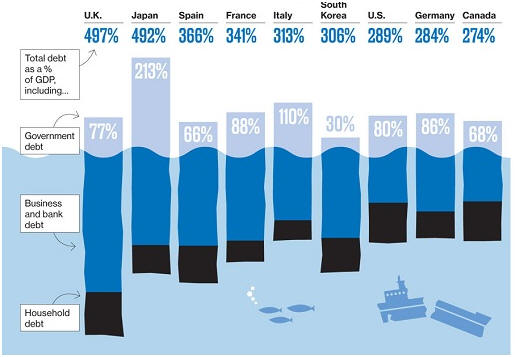
Financial Times London - Can we afford our financial system? The answer is no. Understanding why this is so is a necessary condition for evaluating ideas for reform. The more aware of the risks one is, the more obvious it becomes that radicalism is the safer option. How did this happen? Quite simply, the financial sector has become bigger and riskier. The UK case is dramatic, with banking assets jumping from 50 per cent of GDP to more than 550 per cent over the past four decades. Capital ratios have fallen sharply, while returns on equity have become higher and more volatile. As Mr Haldane notes in another paper, leverage is the chief determinant of returns on equity and increased leverage also explains the level and volatility of banking returns. Finally, the banking sector has also become substantially more concentrated. http://www.ft.com/cms/s/0/f2e4dbb0-4caa-11df-9977-00144feab49a.html

THE NEW GEOLOGICAL ERA - THE ANTHROPOCENE

Humans have wrought such vast and unprecedented changes on the planet that we may be ushering in a new period of geological history. Through pollution, population growth, urbanisation, travel, mining and use of fossil fuels we have altered the planet in ways which will be felt for millions of years, experts believe. It is feared that the damage mankind has inflicted will lead to the sixth largest mass extinction in Earth’s history with thousands of plants and animals being wiped out. The new epoch, called the Anthropocene – meaning new man – would be the first period of geological time shaped by the action of a single species.  new working group of experts has now been established to gather all the evidence which would support recognising it as the successor to the current Holocene epoch. The theory has been proposed by a group of scientists, including Paul Crutzen, the Nobel Prize-winning atmospheric chemist, in the journal Environmental Science & Technology. They conclude: “The Anthropocene represents a new phase in the history of both humankind and of the Earth, when natural forces and human forces became intertwined, so that the fate of one determines the fate of the other. Geologically, this is a remarkable episode in the history of this planet.” Dr Jan Zalasiewicz, of the University of Leicester, co-author of the paper, added: “It is suggested that we are in the train of producing a catastrophic mass extinction to rival the five previous great losses of species and organisms in Earth’s geological past.”

PALESTINIANS RIOT IN JERUSALEM

Jerusalem - Riots erupted in the Holy City as Palestinians marked a ‘day of rage’ in protest at Israeli plans to build 1,600 new homes in the disputed east of the city, which the Palestinians see as the capital of a future state. The announcement of the planned construction has also triggered a diplomatic crisis between Israel and its most important ally, the United States, whose envoy George Mitchell has delayed his return to the region, officials said. Dozens of masked youths pelted Israeli police with rocks and set tyres ablaze in flashpoints across East Jerusalem in the latest clashes to break out as tensions have risen in the past week. Thousands of police have been deployed across the city, and today they fired stun grenades to try to disperse the crowds. About two dozen Palestinians were arrested, officials said.

RATINGS FIRMS CLOSE IN ON BRITAIN

LONDON CONTRIBUTED TO LEHMAN'S COLLAPSE

London - Ernst & Young, Linklaters and Lehman Brothers' London operations played key roles in the investment bank's attempts to mask $50bn (£33bn) of assets on its balance sheet in the run-up to its eventual implosion in September 2008. The two advisers are under fire for their knowledge of a series of complex transactions known officially within the bank as "Repo 105", but referred to by senior staff as "window dressing" and an "accounting gimmick". The pair's actions are questioned in court-appointed investigator Anton Valukas's exhaustive report into the bank's collapse, which also found that British bank Barclays received assets it should not have when later buying Lehman's US brokerage business.

SCIENTISTS CONCLUDE DINOSAURS WIPED OUT BY GIANT ASTEROID

The conclusion by a panel of 41 international scientists, that it was an asteroid that caused the disappearance of the dinosaurs, has come in a bid to end decades of speculation. The giant asteroid hit the earth with the force of a billion Hiroshimas slamming into the Yucatan peninsula in Mexico at 20 times the speed of a bullet causing earthquakes, landslides, tsunamis and wildfires. The destruction, 65 million years ago, was so great it left most of the world a wasteland, shrouded in dust, perpetually cold and virtually devoid of all life and vegetation.

WILL AMERICA, THE FRAGILE EMPIRE, GO THE WAY OF THE DINOSAURS?

For centuries, historians, political theorists, anthropologists and the public have tended to think about the political process in seasonal, cyclical terms. From Polybius to Paul Kennedy, from ancient Rome to imperial Britain, we discern a rhythm to history. Great powers, like great men, are born, rise, reign and then gradually wane. No matter whether civilizations decline culturally, economically or ecologically, their downfalls are protracted. In the same way, the challenges that face the United States are often represented as slow-burning. It is the steady march of demographics -- which is driving up the ratio of retirees to workers -- not bad policy that condemns the public finances of the United States to sink deeper into the red. It is the inexorable growth of China's economy, not American stagnation, that will make the gross domestic product of the People's Republic larger than that of the United States by 2027. As for climate change, the day of reckoning could be as much as a century away. These threats seem very remote compared with the time frame for the deployment of U.S. soldiers to Afghanistan, in which the unit of account is months, not years, much less decades. But what if history is not cyclical and slow-moving but arrhythmic -- at times almost stationary but also capable of accelerating suddenly, like a sports car? What if collapse does not arrive over a number of centuries but comes suddenly, like a thief in the night? Great powers are complex systems, made up of a very large number of interacting components that are asymmetrically organized, which means their construction more resembles a termite hill than an Egyptian pyramid. They operate somewhere between order and disorder. Such systems can appear to operate quite stably for some time; they seem to be in equilibrium but are, in fact, constantly adapting. But there comes a moment when complex systems "go critical." A very small trigger can set off a "phase transition" from a benign equilibrium to a crisis -- a single grain of sand causes a whole pile to collapse. Not long after such crises happen, historians arrive on the scene. They are the scholars who specialize in the study of "fat tail" events -- the low-frequency, high-impact historical moments, the ones that are by definition outside the norm and that therefore inhabit the "tails" of probability distributions -- such as wars, revolutions, financial crashes and imperial collapses. But historians often misunderstand complexity in decoding these events. They are trained to explain calamity in terms of long-term causes, often dating back decades. This is what Nassim Taleb rightly condemned in "The Black Swan" as "the narrative fallacy." n reality, most of the fat-tail phenomena that historians study are not the climaxes of prolonged and deterministic story lines; instead, they represent perturbations, and sometimes the complete breakdowns, of complex systems. To understand complexity, it is helpful to examine how natural scientists use the concept. Think of the spontaneous organization of termites, which allows them to construct complex hills and nests, or the fractal geometry of water molecules as they form intricate snowflakes. Human intelligence itself is a complex system, a product of the interaction of billions of neurons in the central nervous system. All these complex systems share certain characteristics. A small input to such a system can produce huge, often unanticipated changes -- what scientists call "the amplifier effect." Causal relationships are often nonlinear, which means that traditional methods of generalizing through observation are of little use. Thus, when things go wrong in a complex system, the scale of disruption is nearly impossible to anticipate. There is no such thing as a typical or average forest fire, for example. To use the jargon of modern physics, a forest before a fire is in a state of "self-organized criticality": It is teetering on the verge of a breakdown, but the size of the breakdown is unknown. Will there be a small fire or a huge one? It is nearly impossible to predict. The key point is that in such systems, a relatively minor shock can cause a disproportionate disruption. Any large-scale political unit is a complex system. Most great empires have a nominal central authority -- either a hereditary emperor or an elected president -- but in practice the power of any individual ruler is a function of the network of economic, social and political relations over which he or she presides. As such, empires exhibit many of the characteristics of other complex adaptive systems -- including the tendency to move from stability to instability quite suddenly. The most recent and familiar example of precipitous decline is the collapse of the Soviet Union. With the benefit of hindsight, historians have traced all kinds of rot within the Soviet system back to the Brezhnev era and beyond. Perhaps, as the historian and political scientist Stephen Kotkin has argued, it was only the high oil prices of the 1970s that "averted Armageddon." But this did not seem to be the case at the time. The Soviet nuclear arsenal was larger than the U.S. stockpile. And governments in what was then called the Third World, from Vietnam to Nicaragua, had been tilting in the Soviets' favor for most of the previous 20 years. Yet, less than five years after Mikhail Gorbachev took power, the Soviet imperium in central and Eastern Europe had fallen apart, followed by the Soviet Union itself in 1991. If ever an empire fell off a cliff, rather than gently declining, it was the one founded by Lenin.If empires are complex systems that sooner or later succumb to sudden and catastrophic malfunctions, what are the implications for the United States today? First, debating the stages of decline may be a waste of time -- it is a precipitous and unexpected fall that should most concern policymakers and citizens. Second, most imperial falls are associated with fiscal crises. Alarm bells should therefore be ringing very loudly indeed as the United States contemplates a deficit for 2010 of more than $1.5 trillion -- about 11% of GDP, the biggest since World War II. These numbers are bad, but in the realm of political entities, the role of perception is just as crucial. In imperial crises, it is not the material underpinnings of power that really matter but expectations about future power. The fiscal numbers cited above cannot erode U.S. strength on their own, but they can work to weaken a long-assumed faith in the United States' ability to weather any crisis. One day, a seemingly random piece of bad news -- perhaps a negative report by a rating agency -- will make the headlines during an otherwise quiet news cycle. Suddenly, it will be not just a few policy wonks who worry about the sustainability of U.S. fiscal policy but the public at large, not to mention investors abroad. It is this shift that is crucial: A complex adaptive system is in big trouble when its component parts lose faith in its viability. Over the last three years, the complex system of the global economy flipped from boom to bust -- all because a bunch of Americans started to default on their subprime mortgages, thereby blowing huge holes in the business models of thousands of highly leveraged financial institutions. The next phase of the current crisis may begin when the public begins to reassess the credibility of the radical monetary and fiscal steps that were taken in response. Neither interest rates at zero nor fiscal stimulus can achieve a sustainable recovery if people in the United States and abroad collectively decide, overnight, that such measures will ultimately lead to much higher inflation rates or outright default. Bond yields can shoot up if expectations change about future government solvency, intensifying an already bad fiscal crisis by driving up the cost of interest payments on new debt. Just ask Greece. Ask Russia too. Fighting a losing battle in the mountains of the Hindu Kush has long been a harbinger of imperial fall. What happened 20 years ago is a reminder that empires do not in fact appear, rise, reign, decline and fall according to some recurrent and predictable life cycle. It is historians who retrospectively portray the process of imperial dissolution as slow-acting. Rather, empires behave like all complex adaptive systems. They function in apparent equilibrium for some unknowable period. And then, quite abruptly, they collapse. Washington, you have been warned. Niall Ferguson is a professor at Harvard University and Harvard Business School, and a fellow of Jesus College, Oxford.

TRAGEDY HITS CHILE IN MASSIVE QUAKE

A huge earthquake has shaken Chile, killing more than 200 people, causing buildings to collapse, starting fires and unleashing a tsunami across the Pacific. With a magnitude of 8.8, it opened cracks in the earth, flipped cars and devastated the city of Concepción, 70 miles from the epicentre. The number of dead quickly rose to 214, and is expected to increase. The Chilean president, Michelle Bachelet, declared a "state of catastrophe" as emergency teams scrambled over rubble looking for survivors. The Pacific Tsunami Warning Centre issued an alert for countries in Latin America as well as Japan, Russia, the Philippines, Indonesia and French Polynesia. A massive wave hit Robinson Crusoe island, the largest of the Juan Fernández archipelago, where at least three people were killed. Residents were evacuated from the coastal areas of Easter Island.

NASA PROBE FINDS TREES ON MARS

Unfortunately for our science fiction fans the trees are actually trails of dark basaltic sand debris and erupting dust clouds caused by landslides as dry ice (composed of frozen carbon dioxide) melts off the dunes during Martian spring.

AMONGST ALL THE BAD NEWS SOMETHING SPARKLES!

Gemstone producer Gemfields today announced the discovery of an 'exceptional' 6,225 carat rough emerald in its Kagem mine in Zambia. The emerald was recovered during normal mining operations on February 5, the company said in a statement, and is being examined by Gemfields' experts to establish a clearer understanding of its value and significance. The emerald has been named "Insofu" (which means "elephant" in the language of the Bemba people indigenous to the region) due to its size and in honour of the World Land Trust's "Wild Lands Elephant Corridor Project", of which Gemfields is a participant.

MAN JAILED IN DUBAI FOR WEARING THIS T-SHIRT

Dubai - A man has been jailed in Dubai for wearing a cancer awareness Marc Jacobs T-shirt featuring a nearly-nude picture of Victoria Beckham. A number of celebrities, including the actress Winona Ryder and the model Naomi Campbell, posed for the T-shirts, which aim to raise money for a skin cancer research project at New York University. Raffi Nernekian, a Lebanese national, was arrested after an argument with a local man about the T-shirt, in which the key parts of Beckham's body are obscured either by her hands or the logo 'Protect the skin you're in'. Mr Nernekian was subsequently jailed for offending public decency for a month, a sentence upheld on appeal. He will be deported after serving his sentence, even though he has lived in the city for five years. Mr Nernekian's brother said he bought the T-shirt on a visit to New York. It was one of a series produced by the designer Marc Jacobs, for whose local agents Mr Nernekian works as a brand manager. A number of celebrities, including the actress Winona Ryder and the model Naomi Campbell, posed for the T-shirts, which aim to raise money for a skin cancer research project at New York University. Mr Nernekian was approached in a bakery by a local man who complained about his T-shirt. After an argument, he left to change, but when he returned he found the police waiting for him.

IS A GREEK TRAGEDY COMING TO THE USA?

Financial Times: It began in Athens. It is spreading to Lisbon and Madrid. But it would be a grave mistake to assume that the sovereign debt crisis that is unfolding will remain confined to the weaker eurozone economies. The Obama administration’s new budget blithely assumes real GDP growth of 3.6 per cent over the next five years, with inflation averaging 1.4 per cent. But with rising real rates, growth might well be lower. Under those circumstances, interest payments could soar as a share of federal revenue – from a tenth to a fifth to a quarter. Last week Moody’s Investors Service warned that the triple A credit rating of the US should not be taken for granted. That warning recalls Larry Summers’ killer question (posed before he returned to government): “How long can the world’s biggest borrower remain the world’s biggest power?” On reflection, it is appropriate that the fiscal crisis of the west has begun in Greece, the birthplace of western civilization. Soon it will cross the channel to Britain. But the key question is when that crisis will reach the last bastion of western power, on the other side of the Atlantic.

IRANIAN TROOPS

SHARKS IN WAITING

These tankers have been parked off the British coast for months, refusing to unload their oil until prices have risen even higher. The delay makes millions for speculators... and keeps your petrol costs soaring. Laden with fuel, three oil tankers sit idly within sight of the British coastline, playing a waiting game that is driving up petrol prices for hard-pressed motorists. They are part of a flotilla of ten vessels refusing to unload their cargo until market speculation has driven up its price to the level they want. And as the value of that cargo is currently rising by over £1million a day, driven partly by profiteering traders and speculators, it is unlikely to see a petrol station any time soon.

WATER ON MOON

“Indeed yes, we found water,” Anthony Colaprete, the principal investigator for NASA’s Lunar Crater Observation and Sensing Satellite, said in a news conference. “And we didn’t find just a little bit. We found a significant amount.” The confirmation of scientists’ suspicions is welcome news to explorers who might set up home on the lunar surface and to scientists who hope that the water, in the form of ice accumulated over billions of years, holds a record of the solar system’s history. The satellite, known as Lcross (pronounced L-cross), crashed into a crater near the Moon’s south pole a month ago. The 5,600-miles-per-hour impact carved out a hole 60 to 100 feet wide and kicked up at least 26 gallons of water. “We got more than just a whiff,” Peter H. Schultz, a professor of geological sciences at Brown University and a co-investigator of the mission, said in a telephone interview. “We practically tasted it with the impact.”

A GIGANTIC FINANCIAL CUCKOO IN THE NEST

FIGHTING THE TALIBAN IN PAKISTAN

The Pakistani military says it has seized Taliban bases during the first day of a ground offensive in South Waziristan. At least five soldiers and 11 fighters were killed in the fighting, Pakistani officials said on Sunday. As many as 150,000 civilians have left the area in recent months after the army made clear it was planning an assault. But there are perhaps as many as 350,000 still in the region. Security forces captured a Taliban stronghold at Spinkai Raghzai on Saturday after the fighters withdrew from their fortifications and took refuge in nearby mountains, officials said. Earlier, the officials reported that gun battles were taking place outside Spinkai Raghzai as well as Kalkala and Sharwangai. Intelligence officials said the ground troops were advancing on two flanks and a northern front of a central part of South Waziristan controlled by the Mehsuds. The areas being surrounded include the Taliban bases of Ladha and Makeen, the officials said.

NASA CRASHES ROCKET ON MOON

MOFFETT FIELD, Calif. -- NASA's Lunar Crater Observation and Sensing Satellite, or LCROSS, created twin impacts on the moon's surface early Friday in a search for water ice. Scientists will analyze data from the spacecraft's instruments to assess whether water ice is present. The satellite traveled 5.6 million miles during an historic 113-day mission that ended in the Cabeus crater, a permanently shadowed region near the moon's south pole. The spacecraft was launched June 18 as a companion mission to the Lunar Reconnaissance Orbiter from NASA's Kennedy Space Center in Florida.

BRITISH ARMY IN AFGHANISTAN

DOUBTS OVER AFGHANISTAN

KABUL, Afghanistan — A powerful suicide bomb that killed six Italian soldiers here on Thursday prompted Prime Minister Silvio Berlusconi of Italy to declare that his nation had begun planning to “bring our young men home as soon as possible." In Brussels, Mr. Berlusconi, a close American ally but in political trouble at home, was careful to say that Italy would not unilaterally withdraw its 3,100 troops from Afghanistan, though he said he wanted the withdrawal to happen “as quickly as possible.” But it seemed the strongest expression yet from a European leader of the rising doubts about the Afghanistan mission among America’s allies.

STOCK MARKET ROLLERCOASTER RIDE

For equity investors, 2009 has been a white-knuckle ride. The roller coaster journey has seen the FTSE 100 slump to 3,512 before peaking at 4,638, all within six months. A dismal start to the year paved the way for a rally in March, which in turn was followed by a bout of profit taking, before stocks started climbing once again – despite corporate earnings and economic news remaining mixed. On Friday, worse-than-expected figures showed that UK GDP had fallen by a record 0.8pc in the second quarter. The economy has now shrunk by 5.7pc over the last year. Yet the FTSE 100 continued its buoyant run, closing at 4,576, a tenth straight gain. It is now up nearly 9pc since this latest winning run started on July 13. There was a similar story overseas. The Dow Jones passed 9,000 for the first time since January, the S&P 500 hit its highest level since Barack Obama came to office and the Nasdaq was enjoying its biggest run of gains since 1992. Asian markets also enjoyed an upbeat week. Equities are not meant to rally in the middle of the year; the summer months tend to be typified by low volumes and drifting markets. "Sell in May and go away, come back on St Leger Day" used to be the traditional trading floor refrain. Yet on Wednesday, the FTSE 100 pushed above 4,500 for the first time since January.

CHINA LIFTING ONE CHILD POLICY

SHANGHAI - The easing of restrictions comes in response to concern about economic problems caused by the country's ageing population. Shanghai is actively promoting the two-child policy as China tries to defuse a demographic time bomb caused by a shortage of young workers after 30 years of tough population growth restrictions. The city government is worried about the rapidly rising number of elderly people and the resulting burden and drag on the Chinese economy. "We advocate eligible couples to have two kids because it can help reduce the proportion of ageing people and alleviate a workforce shortage in the future," said Xie Lingli, the head of Shanghai's family planning commission, to the China Daily newspaper. The policy shift will prove popular. A recent survey released by the Shanghai family planning commission showed that more than half of 4,800 respondents, aged between 20 and 30, said would like a second child if the one-child policy was eased. China's one-child policy was originally designed to make sure the huge country's population remained at a manageable size, given the country's relatively low water, energy and food resources. Experts predicted earlier this week that there will be zero growth in China's population of 1.3 billion people by 2030.

FORTY YEARS AFTER MOON LANDING APOLLO BLASTS OFF

Forty years after the historic Apollo 11 mission to the Moon, Nasa's Space Shuttle Endeavour and seven astronauts blasted off from the Kennedy Space Centre in Florida to begin a 16-day trip to deliver the last piece of Japan's research laboratory to the International Space Station.

BRITAIN BLOCKS SPARE PARTS TO ISRAEL

In a move that threatens to strain diplomatic ties, Britain has blocked the sale of spare parts for Israel’s fleet of missile gunships because they were used in the recent campaign in Gaza. The first country to revoke an arms licence in response to the war in Gaza six months ago, Britain told the Israeli Embassy in London that five of the export requests for parts for the Sa’ar 4.5 gunships had been rejected because the vessels had fired on Gaza during Operation Cast Lead, Israel’s controversial 23-day campaign against the militant group Hamas. The spare parts were intended for the ships’ guns.

OBAMA TALKS TO AFRICA

CAPE COAST, Ghana President Obama traveled in his father’s often-troubled home continent on Saturday, where he symbolized a new political era but brought a message of tough love: American aid must be matched by Africa’s responsibility for its own problems. “We must start from the simple premise that Africa’s future is up to Africans,” Mr. Obama said in an address televised across the continent. For all its previous sins, he said, “the West is not responsible for the destruction of the Zimbabwean economy over the last decade, or wars in which children are enlisted as combatants.” To build a prosperous future, he said, Africa needs to shed corruption and tyranny and take on poverty and disease. “These things can only be done if you take responsibility for your future,” he told Parliament in Accra, Ghana’s capital. “And it won’t be easy. It will take time and effort. There will be suffering and setbacks. But I can promise you this: America will be with you every step of the way, as a partner, as a friend.”

BATTLE AGAINST TALIBAN

At daybreak, some 700 men of the Light Dragoons Battle Group, to which the men of B Company, 2nd Battalion Mercian Regiment (Worcesters and Foresters) are attached, are about to launch the main thrust of Operation Panchai Palang - Panther's Claw - the largest British ground offensive against Afghan insurgents. Considerable airpower and concentrations of armour have been brought to bear. But it has fallen to the Mercians to lead the ground assault. B Company is led by Major Stewart Hill. Before the operation begins, he asks his assembled soldiers: 'Is it to be the insurgents' summer or will it belong to us? Of course, it's going to be ours.' Forward Operating Base Price is in the desert a few kilometres south west of Gereshk. Usually, it is manned by a Danish battle group. Earlier this week it was also the temporary home of the men of the Light Dragoons Battle Group, which includes the 2nd Mercians and their attached support units. Dawn on Wednesday saw the first ground moves of the operation. The Danish battle group moved out of FOB Price, led by three Leopard main battle tanks. Theirs was a diversionary operation, to probe the Taliban and conceal the place at which the first British troops would cross the canal, 48 hours later. To give them credit, the Taliban did not hesitate to engage the approaching heavy armour with small arms fire from across the canal.

CITY OF LONDON RENTS FALL 19%

LONDON - The banking meltdown has seen rents in the City fall by 19 per cent over the past year, new figures show. The collapse of the financial sector has crushed demand for pieds-à-terre in the Square Mile, meaning those still flat hunting can negotiate far better deals with landlords. The average City rent is now £916 a month, still the highest in the capital. A year ago it was £1,217.

MADOFF GETS 150 YEARS PRISON

A criminal saga that began in December with a string of superlatives — the largest, longest and most widespread Ponzi scheme in history — ended the same way on Monday as Bernard L. Madoff was sentenced to 150 years in prison, the maximum for his crimes. Mr. Madoff, looking thinner and more haggard than when he pleaded guilty in March, stood impassively as Federal District Judge Denny Chin condemned his crimes as “extraordinarily evil” and imposed a sentence that was three times as long as the federal probation office suggested and more than 10 times as long as defense lawyers had requested.Though many questions still surround the case, the judge’s pronouncement offered a brief sense of resolution, followed by a short burst of applause and one stifled cheer from the victims who filled the soaring Lower Manhattan courtroom. Only a few moments before, Mr. Madoff had apologized for the harm he inflicted on the clients who had trusted him, his employees and his family. He blamed his pride, which would not allow him to admit his failures as a money manager. “I am responsible for a great deal of suffering and pain. I understand that,” he said, leaning slightly forward over the polished table, his charcoal suit sagging on his diminished frame. “I live in a tormented state now, knowing of all the pain and suffering that I have created.”

CLEVER CARLA AND TROUBLED KAREN MULDER

They were among the first of the fashion supermodels. Inseparable as the pair seemed then, their lives have taken very different directions.On Tuesday this week, while Carla, now Madame Bruni Sarkozy, the French president's wife, consulted her diary for engagements, Karen was in a Paris police station having been arrested for allegedly making death threats to her plastic surgeon.

NASA BLASTS OFF TO PREPARE PATH FOR MANNED LUNAR MISSION BY 2020

Nasa’s most ambitious lunar exploration mission since the Apollo era blasted off from Florida’s Kennedy Space Centre last night — with scientists hoping that a crash landing will pave the way for man to return to the Moon for the first time since 1972. One half of the $580 million project (£350 million) is designed to smash a piece of rocket casing the size of a pick-up truck into a remote crater on the dark side of the Moon, sending up 350 tons of lunar debris that will be analysed by a probe following four minutes behind in an attempt to confirm the existence of water. The other half, a four-metre long robotic satellite known as the Lunar Reconnaissance Orbiter, will spend years circling the Moon at an altitude of 31 miles, scanning its surface in greater detail than ever before and sending back to Earth unprecedented images of areas that could be used as future landing sites and human habitats. The exercise is essential if Nasa is to meet its objective of returning astronauts to the Moon by 2020.

TROUBLE AT WORLD TRADE CENTER

More than seven years after the Twin Towers were destroyed, the public and private bodies involved in the site are still wrangling over fundamental aspects of the reconstruction. Two of the mighty towers planned for the site are in danger of being shrunk to a mere 25 storeys. The astoundingly expensive National September 11 Memorial & Museum has had its projected completion put back so that it is now due to be finished, just in time for the tenth anniversary of 9/11, in 2011. The Freedom Tower, the emblem of the rebuilding, is now rising towards its symbolically significant height of 1,776 feet ( independence), and it is due for completion in 2014.

EXTREME RIGHT BRITISH NATIONALIST PARTY WINS TWO SEATS IN EU PARLIAMENT

Far-Right parties and extremist parties made gains across Europe as protest votes and low turnouts marked the European parliament elections. Anti-immigrantion and far-right groups made significant gains in the Netherlands, Austria, Hungary, Denmark, Slovakia and Finland. Geert Wilders and his far-Right anti-Islamic immigrant party shot to second place behind the ruling Christian Democrats by taking 17 per cent of the vote in the Netherlands. In Austria too, two anti-immigrant far-Right parties took an unprecedented 17.7 per cent of the vote. The far-Right Danish People's Party won two seats and took 14.4 per cent of Denmark's vote. In Slovakia a low turnout of just 19.4 per cent propelled an anti-gipsy extremist ultra-nationalist into the parliament and Hungary's far-Right Jobbik took three seats for the first time.

HANDS ACROSS THE OCEAN AS GORDON LOOKS ON

GOOD NEWS - AT LEAST FOR THIS LUCKY LOTTERY WINNER

OBAMA ADDRESSES MUSLIM WORLD

Pledging to seek a new beginning between the United States and Muslims, President Obama reached out to the world's 1.5 billion followers of Islam on Thursday, addressing an appreciative crowd at Cairo University. Quoting from the Quran, the Talmud and the Bible — and closing to a standing ovation — Obama said his address was an effort to "speak the truth" about U.S. relations with the Muslim world. Several times during the hour-long speech, members of the audience shouted, "We love you."  The same day Obama made his speech, a seven-month-old baby died in the intensive care unit of the European Gaza Hospital in the Gaza Strip. His name was Zein Ad-Din Mohammed Zu’rob, and he was suffering from a lung infection which was treatable. Denied basic equipment, the doctors in Gaza could do nothing. For weeks, the child’s parents had sought a permit from the Israelis to allow them to take him to a hospital in Jerusalem, where he would have been saved. Like many desperately sick people who apply for these permits, the parents were told they had never applied. Even if they had arrived at the Erez Crossing with an Israeli document in their hands, the odds are that they would have been turned back for refusing the demands of officials to spy or collaborate in some way.
NORTH KOREA TESTS ATOMIC BOMB
North Korea is led by a communist dynastic ruler, Kim Jong-il, who suceeded his father as the country's dictator and now intends to install his son, Kim Jong-un as his successor.

THIS MAN THREATENS PEACE IN ASIA

NO ITS NOT GHOST BUSTERS - ITS A NEW YORK DISASTER EXERCISE

TAMIL TIGER LEADER SHOT DEAD

The leader of Sri Lanka's Tamil Tiger rebels, Velupillai Prabhakaran, has been killed along with his son and other Tiger commanders, according to reports. Prabhakaran was ambushed and shot dead while trying to flee government troops as special forces closed in on the last rebel fortifications, it was reported today. However that account of events was disputed by a military spokesman who said that there had been no identification of Prabhakaran as yet.
The Sri Lankan army killed a number of other senior Tamil Tiger commanders as fighting continued to rage despite the Tigers' weekend admission of defeat. Brigadier Udaya Nanayakkara, a military spokesman, said that commando units and other crack government troops were trading machine gun fire with “a couple of hundred” of Tiger fighters hunkered down in fortified bunkers, thought to include several senior rebel leaders. The conflict area had been reduced to a patch of land just 100 metres by 100 metres, he added. Tens of thousands of civilians who had been caught in the crossfire were finally allowed to flee to freedom over the weekend.
A senior defence official said Prabhakaran had been killed while trying to flee the area in an ambulance with two close aides. "He was killed with two others inside the vehicle," the official told AFP. The government said that they had found the body of Prabhakaran's 24 year old son Charles Anthony, the heir apparent of the Tigers’ leadership. The head of the rebels’ political wing, Balasingham Nadesan, the head of the Tigers' defunct peace secretariat, Seevaratnam Puleedevan, and their eastern leader, S. Ramesh were also said to be among the dead. Independent verification of the situation is all but impossible as journalists are not being allowed near the conflict zone. The International Committee of the Red Cross, the only neutral organisation allowed access, said that it had lost contact with its 25 staff members on the battlefield yesterday morning.

Manhattan Declaration on Climate Change

“Global warming” is not a global crisis

We, the scientists and researchers in climate and related fields, economists, policymakers, and business leaders, assembled at Times Square, New York City, participating in the 2008 International Conference on Climate Change,

Resolving that scientific questions should be evaluated solely by the scientific method;

Affirming that global climate has always changed and always will, independent of the actions of humans, and that carbon dioxide (CO2) is not a pollutant but rather a necessity for all life;

Recognising that the causes and extent of recently-observed climatic change are the subject of intense debates in the climate science community and that oft-repeated assertions of a supposed ‘consensus’ among climate experts are false;

Affirming that attempts by governments to legislate costly regulations on industry and individual citizens to encourage CO2 emission reduction will slow development while having no appreciable impact on the future trajectory of global climate change.  Such policies will markedly diminish future prosperity and so reduce the ability of societies to adapt to inevitable climate change, thereby increasing, not decreasing human suffering;

Noting that warmer weather is generally less harmful to life on Earth than colder:

Hereby declare:

That current plans to restrict anthropogenic CO2 emissions are a dangerous misallocation of intellectual capital and resources that should be dedicated to solving humanity’s real and serious problems.

That there is no convincing evidence that CO2 emissions from modern industrial activity has in the past, is now, or will in the future cause catastrophic climate change.

That attempts by governments to inflict taxes and costly regulations on industry and individual citizens with the aim of reducing emissions of CO2 will pointlessly curtail the prosperity of the West and progress of developing nations without affecting climate.

That adaptation as needed is massively more cost-effective than any attempted mitigation, and that a focus on such mitigation will divert the attention and resources of governments away from addressing the real problems of their peoples.

That human-caused climate change is not a global crisis.

Now, therefore, we recommend –

That world leaders reject the views expressed by the United Nations Intergovernmental Panel on Climate Change as well as popular, but misguided works such as “An Inconvenient Truth”.

That all taxes, regulations, and other interventions intended to reduce emissions of CO2 be abandoned forthwith.

Agreed at New York, 4 March 2008.

POPE  - ONCE A MEMBER OF HITLER YOUTH CONDEMNS ANTI-SEMITISM ON VISIT TO HOLY LAND

Pope Benedict used his first speech in Israel to remember the six million Jews killed by the Nazis and try to heal fresh wounds over his reinstatement of a bishop who denied the Holocaust. In the 45 years since the Second Vatican Council rejected the concept of collective Jewish guilt for Christ's death, Catholic-Jewish relations have been haunted by the Holocaust and the question of what the church did, or failed to do, about it. They went through one of their worst periods in January after the pope lifted the excommunication of four traditionalist bishops, including one who denied six million Jews were killed. The Vatican says it had not known enough about that British bishop's past and the church and Jewish religious leaders now hope the issue can be closed with a visit later in the day by the pontiff to Yad Vashem in Jerusalem, Israel's memorial to the victims of the Holocaust.The pontiff also called for the establishment of an independent Palestinian homeland - putting him at odds with the new Israeli government. 'Tragically, the Jewish people have experienced the terrible circumstances of ideologies that deny the fundamental dignity of every human person,' he said. I will have the opportunity to honour the memory of the six million Jewish victims of the Shoah,' the German-born pope said, using the Hebrew term for the Holocaust, 'and to pray that humanity will never again witness a crime of such magnitude'. Pope Benedict was forced to join the Hitler Youth when he reached the age of 14, in 1941. According to his official biography, he was an unenthusiastic member and refused to attend meetings although he later served in a Hitler Youth anti-aircraft unit. The Pope, who flew into Israel from Jordan, lashed out at anti-Semitism, which he said 'continues to rear its ugly head' in many parts of the world.

Pope Benedict XVI pictured aged 16 in an anti-aircraft unit of the Hitler Youth
Pope Benedict angered many in the Muslim world three years ago when he quoted a Medieval text that characterized some of Islam's Prophet Muhammad's teachings as 'evil and inhuman,' particularly 'his command to spread by the sword the faith. He later expressed regret that his comments offended Muslims. Benedict also sparked outrage earlier this year among Jews when he revoked the excommunication of an ultraconservative bishop who denies the Holocaust. Later today, Benedict is scheduled to lay a wreath at Israel's Yad Vashem Holocaust memorial. In bidding farewell to Benedict, Abdullah issued a strong call for a two-state solution for Israelis and Palestinians. During his three days in Jordan, the pope said he hoped the Catholic Church could be a force for peace in the region. 'It is time the suffering ended through a settlement that will guarantee the Palestinians their rights to freedom and statehood and give Israelis the acceptance and security they need,' Abdullah told the Pope.

BRITONS SEEK SURROGATE MOTHERS IN INDIA

Growing numbers of British couples are going to India to pay surrogate mothers to have their children. One father from Ilford told how he and his wife had spent 13 years trying to have a baby, before succeeding through a surrogate mother in Mumbai at a cost of £50,000. The sperm was donated by Bobby Bains, who is a Sikh, and the eggs by a Hindu woman while the surrogate mother who carried his daughter Daisy for nine months is Muslim. The Indian surrogacy industry has become a multi-million-pound business and has prompted calls for it to be regulated. Bains and his wife Nikki, 44, who are trying for a second surrogate child, said that on a recent trip Bains was shown a seventh-floor flat which housed 12 pregnant surrogate mothers. Each mother is paid between £2,500 and £3,500 for carrying a child - equivalent to as much as 10 years' wages for some of the women on the clinic's books. One report suggests Indian women with fairer skin and higher IQs can charge more for donating eggs, fertilised in a test tube and then implanted in the surrogate mother. Bains said: "There are hundreds of clinics doing this in India. A clinic in Gujarat has 50 pregnancies. There is one baby born every week. Fifty girls are staying in surrogate houses. In one flat I went to there were pregnant women sitting around watching daytime Indian soaps.” The babies born in the Indian clinics also face being effectively stateless and parents can have long battles to get British passports for their children. He estimates that more than half the inquiries are from Europeans and about one third, or 100 a year, are from the UK. Of those about 90 per cent are Caucasians. It is estimated that about 50 pregnant surrogate mothers are being looked after by the clinic at any one time. The clinic charges around £15,000 for each surrogate baby born while it costs about £4,000 for each failed attempt. In all about 140 surrogate mothers give birth through the clinic each year. Dr Gautam Allapadia, a fertility specialist at the Rotunda clinic, said: “The costs are substantially less than they would spend in developed countries like the US and the UK.

THE INDEPENDENT NEW YORK TIMES PRESENTS A ROUNDUP OF THE WEEKLY NEWS

PLEASE LET US HAVE YOUR COMMENTS AND OPINIONS

CONTACT OUR EDITOR AT sumpinein@gmail.com


EMIRATES ORDERS 32 SUPER AIRBUSES FOR $11.5 BILLION

Emirates ratcheted up the pressure on Europe’s airlines, spending $11.5 billion on 32 new super Airbuses that will enable it to grab market share and cut long-haul fares by up to half. The Gulf airline’s Airbus order — the largest for commercial aircraft — will take its A380 fleet to 90, more than four times as large as the next operator Qantas. The double-decker aircraft will add huge numbers of new seats on key routes such as London to Dubai, pushing down fares as capacity increases. Emirates fares are already typically 25 to 50 per cent cheaper than those offered by European rivals. The additional capacity offered by the A380s could make it increasingly difficult for older flag carriers such as British Airways to compete on certain routes.

JAGUAR LAND ROVER TO BUILD CARS IN CHINA

BBC - Carmaker Jaguar Land Rover is going to start assembling vehicles in China, the BBC can confirm. "We will need to manufacture at least two models in China," said chief executive Carl-Peter Forster in an interview. "We'll take one to two years to set it up, but first we will need a partner." The company said the move into China is not a shift out of the UK, where it is planning to hire an extra 1,000 workers this year. The new jobs that are being created will be temporary and are linked to the production of new compact Range Rover model due next year - the production version of the Land Rover LRX that was revealed earlier. "It takes a year or two before the jobs become permanent," said Mr Forster, who is also chief executive of Tata Motors, Jaguar Land Rover's parent company. Last year, Jaguar Land Rover's workforce in the UK was reduced by about 2,500 people to 16,000.

BRITAIN WAS ILL PREPARED

THE TIMES LONDON - Military chiefs and civil servants ignored warnings that Britain was ill prepared to send troops to Helmand and signed off a deeply flawed plan, a succession of senior figures have told The Times. Even those in charge of the deployment admit that the decision to go to southern Afghanistan in 2006, which has cost the lives of nearly 300 servicemen and women, was a gamble and that mistakes were made because of poor intelligence. They insist, however, that the operation was justified to revitalise the Nato mission, combat the Taleban and reassert Britain’s military prowess after setbacks in Iraq. But a two-month investigation by The Times, which includes interviews with 32 senior military, political and Civil Service figures, reveals that there was deep disquiet over the handling of the mission from the start.

SIX TIMES SPEED OF SOUND

The X-51A Waverider was released from a B-52 Stratofortress off the southern California coast and its scramjet engine accelerated the aircraft to Mach 6, and it flew autonomously for 200 seconds before losing acceleration. At that point the test was terminated. "We are ecstatic to have accomplished many of the X-51A test points during its first hypersonic mission," said Charlie Brink, an X-51A program manager with the Air Force Research Laboratory at Wright-Patterson Air Force Base, Ohio. "We equate this leap in engine technology as equivalent to the post-World War II jump from propeller-driven aircraft to jet engines," he said. The Waverider was built for the Air Force by Pratt & Whitney Rocketdyne and Boeing Co.

RED SHIRTS SURRENDER

BANGKOK - An anti-government 'red shirt' supporter surrenders to army soldiers clearing an encampment of thousands of protesters in Bangkok.

BRITAIN  EXPELS ISRAELI DIPLOMAT

London - The UK expels an Israeli diplomat over the use of twelve cloned British passports in a Dubai murder, the BBC has learned. Foreign Secretary David Miliband will make a statement to Parliament later. Israel has said there is no proof that its agents were behind the killing of Mahmoud al-Mabhouh in a Dubai hotel room in January. Diplomatic sources stressed the British government has stopped short of accusing Israel of the murder. However Mr Miliband had demanded that Israel co-operate fully with the investigation into how the passports were obtained. The foreign secretary is to make the statement after Britain's Serious Organised Crime Agency found proof of the cloned passports, said BBC correspondent Jeremy Bowen.

GO TO DUBAI AND GO TO JAIL  BRITONS FACE JAIL FOR KISSING

Two Britons accused of kissing in public in Dubai face up to a month in prison after a mother complained her child had seen them. Ayman Najafi, 24, from Palmers Green, and a female friend named by the Sun as tourist Charlotte Lewis, 25, launched an appeal in a Dubai court today but will have to wait three weeks to find out if they have been successful. Najafi, who has lived in Dubai for the past 18 months, and Lewis were arrested last November and accused of kissing, touching each other intimately and consuming alcohol. The couple admitted having drunk alcohol. Drinking alcohol in licensed bars and restaurants is not illegal in Dubai, but being out in public afterwards is. The pair, currently free on bail, were also fined 1,000 dirhams (£178) for illegal consumption of alcohol, the lawyer said. They had their passports confiscated and were to be deported after the completion of their jail sentence. A lawyer for the pair said there had been no inappropriate kissing and the pair were just friends. "There was no lip kissing. It was just a normal greeting that is not considered offensive," Khalaf al-Hosani told AFP, adding the complainant's testimony was contradictory.
CHURCH HIT BY ABUSE SCANDAL IN GERMANY

Berlin — A widening child sexual abuse inquiry in Europe has landed at the doorstep of Pope Benedict XVI, as a senior church official acknowledged Friday that a German archdiocese made “serious mistakes” in handling an abuse case while the pope served as its archbishop. The archdiocese said that a priest accused of molesting boys was given therapy in 1980 and later allowed to resume pastoral duties, before committing further abuses and being prosecuted. Pope Benedict, who at the time headed the Archdiocese of Munich and Freising, approved the priest’s transfer for therapy. A subordinate took full responsibility for allowing the priest to later resume pastoral work, the archdiocese said in a statement.

AHMADINEJAD WANTS ZIONIST FREE MIDDLE EAST

The United States should pack up and leave the Middle East and stay out of regional affairs, Iran's president said Thursday during a visit to Damascus that follows a string of US efforts to break up Syria's 30-year alliance with Teheran. Iranian President Mahmoud Ahmadinejad said Arab nations will usher in a new Middle East 'without Zionists and without colonialists.' '(The Americans) want to dominate the region but they feel Iran and Syria are preventing that,' Ahmadinejad said during a news conference with Syrian President Bashar Assad. 'We tell them that instead of interfering in the region's affairs, to pack their things and leave.' He said that 'if the Zionist regime wants to repeat its past mistakes, this will constitute its demise and annihilation.' Ahmadinejad said Iran, Syria, Iraq and Lebanon will stand against Israel.

KILLER WHALE DRAGS TRAINER TO DEATH

Tourists in Florida watched in horror as a five-tonne killer whale surged out of the water and grabbed its trainer during a performance, thrashing her around and holding her under until she was dead. Paramedics at the theme park in Orlando were unable to revive Dawn Brancheau, 40, one of SeaWorld's most experienced trainers, after yesterday's incident. It is the third human death to which Tillikum, the largest Orca whale in captivity, has been linked.

TOMB OF SAXON QUEEN DISCOVERED

The crumbling remains of Alfred the Great's granddaughter - a Saxon princess who married one of the most powerful men in Europe - have been unearthed more than 1,000 years after her death. The almost intact bones of Queen Eadgyth - the early English form of Edith - were discovered wrapped in silk, inside a lead coffin in a German cathedral. Eadgyth - one of the oldest members of the English royal family - was given in marriage to the influential Holy Roman Emperor Otto I and lived in Germany until her death in 946AD, aged 36.

FRANCE TOP 5th YEAR RUNNING

Britain has dropped to 25th place on a list of the best places in the world to live  -  behind countries such as the Czech Republic, Lithuania and Uruguay. While France tops the poll for the fifth year running, the UK's climate, crime rate, cost of living, congested roads and overcrowded cities have pushed it even further down from last year's ranking at 20. The Quality of Life Index, published by International Living magazine for the 30th year, says the French live life to the full, while Britons are over-worked. http://www.internationalliving.com/Internal-Components/Further-Resources/qofl2009

IS THIS THE ANSWER TO CLIMATE CHANGE?

THE WORLD ABOUT TO GO UNDER?

Dubai World, one of the emirate's main state holding companies, said it was asking for a delay on maturities until at least May 30. It has $60bn  in declared liabilities and one of its subsidiaries, the "palm island" developer Nakheel, is due a $3.52bn Islamic bond repayment, plus charges, on December 14. The company also unveiled a restructuring programme. Dubai World's major asset is DP World. Questions will be asked whether a stake in DP World or other successful Dubai entities like Emirates Airlines might ultimately have to be sold to raise cash. Earlier in the day, Dubai's government announced it had raised a $5bn bond for its Financial Support Fund from government-owned banks in neighbouring Abu Dhabi. Dubai was among the most dramatic victims of the credit crunch, with property prices halving from their highs in September 2008, leaving a huge overhang of debt. Much of it was in the hands of government-owned companies, with Nakheel, which has been forced to slow work on show-piece developments like its artificial island chain The World, among the most prominent. The government's statement made no mention of default but left other questions unanswered. "The Dubai Financial Support Fund, working with the chief restructuring officer, will start to assess and evaluate the extent of the restructuring required," it said. "As a first step, Dubai World intends to ask all providers of financing to Dubai World and Nakheel to 'standstill' and extend maturities until at least May 30." Dubai's sovereign credit default swaps jumped 111 basis points to 429 – higher than Iceland's.

COMMERCIAL REAL ESTATE COLLAPSE?

NEW YORK (Fortune)  - When the FDIC closed Chicago's Corus Bank last month, it may have signalled the beginning of the next shock to the banking system: commercial real estate defaults. Corus, whose balance sheet was larded with bad construction loans, is just one of many banks that have a slew of this debt on their books. Refinancing the $2 trillion in commercial mortgages will be tough, as property values decline. And in this new age of cautious lending, few banks are willing to refinance loans. 'There is a lack of new debt,' says Michael Haas, a real estate attorney at Jones Day. 'There is a hesitancy to extend credit when there is a real possibility that the real estate may be worth less than it was a few years ago.' Now, in a situation eerily similar to the subprime crisis, the result is likely to be a wave of foreclosures and loan defaults that could, in turn, trigger a collapse in the market of the structured bonds backed by commercial real estate and construction debt.

 MALDIVES UNDERWATER CABINET MEETING

Maldives Ministers Dive Into Cabinet Meeting Ministers in the Maldives have taken part in their first underwater cabinet meeting to draw attention to global warming. President Mohamed Nasheed plunged first into the Indian Ocean followed by his ministers, all clad in scuba gear, for the nationally televised meeting. Mr Nasheed and his deputy, Mohamed Waheed, and a dozen ministers sat behind tables arranged in a horseshoe at a depth of 6m (20ft). They approved a resolution urging global action to cut carbon emissions. Tropical reef fish swam among the ministers and the nation's red and green flag with white crescent moon was planted in the sea bed behind Mr Nasheed.After surfacing, he called for the UN's climate summit in Copenhagen in December to forge a deal to reduce carbon emissions blamed for rising sea levels that experts say could swamp the Maldives by the end of the century.

MEET YOUR ANCESTOR

An ancient human-like creature that may be a direct ancestor to our species has been described by researchers. The assessment of the 4.4-million-year-old animal called Ardipithecus ramidus is reported in the journal Science. Even if it is not on the direct line to us, it offers new insights into how we evolved from the common ancestor we share with chimps, the team says. Fossils of A. ramidus were first found in Ethiopia in 1992, but it has taken 17 years to assess their significance. The most important specimen is a partial skeleton of a female nicknamed "Ardi". The international team has recovered key bones, including the skull with teeth, arms, hands, pelvis, legs, and feet. But the researchers have other fragments that may represent perhaps at least 36 different individuals, including youngsters, males, and females. One of the lead scientists on the project, Professor Tim White from the University of California, Berkeley, said the investigation had been painstaking. "It took us many, many years to clean the bones in the National Museum of Ethiopia and then set about to restore this skeleton to its original dimensions and form; and then study it and compare it with all the other fossils that are known from Africa and elsewhere, as well as with the modern age," he told the journal. "This is not an ordinary fossil. It's not a chimp. It's not a human. It shows us what we used to be."

A TINY KILLER

A miniature version of Tyrannosaurus rex, the size of a human being, has been discovered after an extraordinary fossil that had been almost lost to the black market was recovered for science. T. rex, which lived 60 million years later than its smaller cousin, shared its body shape in almost every detail, with an outsized skull, powerful jaws and teeth, athletic hind legs built for pursuing prey and puny forearms. Raptorex kriegsteini, however, was only a fifth as long as its more celebrated successor, 100 times lighter and only 3m (9ft) from head to tail and 65kg (10st 3lb). T. rex grew to 13m and 7 tonnes and at the hip was more than twice as tall as a person.

LEOPARD GETS BETTER OF CROC

HEALTH CARE FOR POOR IN US

Wendell Potter can remember exactly when he took the first steps on his journey to becoming a whistleblower and turning against one of the most powerful industries in America. It was July 2007 and Potter, a senior executive at giant US healthcare firm Cigna, was visiting relatives in the poverty-ridden mountain districts of northeast Tennessee. He saw an advert in a local paper for a touring free medical clinic at a fairground just across the state border in Wise County, Virginia. Potter, who had worked at Cigna for 15 years, decided to check it out. What he saw appalled him. Hundreds of desperate people, most without any medical insurance, descended on the clinic from out of the hills. People queued in long lines to have the most basic medical procedures carried out free of charge. Some had driven more than 200 miles from Georgia. Many were treated in the open air. Potter took pictures of patients lying on trolleys on rain-soaked pavements. For Potter it was a dreadful realization that healthcare in America had failed millions of poor, sick people and that he, and the industry he worked for, did not care about the human cost of their relentless search for profits. "It was over-powering. It was just more than I could possibly have imagined could be happening in America. Potter resigned shortly afterwards. Last month he testified in Congress, becoming one of the few industry executives to admit that what its critics say is true: healthcare insurance firms push up costs, buy politicians and refuse to pay out when many patients actually get sick. In chilling words he told a Senate committee: "I worked as a senior executive at health insurance companies and I saw how they confuse their customers and dump the sick: all so they can satisfy their Wall Street investors." Potter's claims are at the centre of the biggest political crisis of Barack Obama's young presidency. Obama, faced with 47 million Americans without health insurance, has put reforming the system at the top of his agenda. If he succeeds, he will have pushed through one of the greatest changes to domestic policy of any president. If he fails, his presidency could be broken before it is even a year old. Last week, in a sign of how high the stakes are, he addressed the nation in a live TV news conference. It is the sort of event usually reserved for a moment of deep national crisis, such as a terrorist attack. But Obama wanted to talk about healthcare. "This is about every family, every business and every taxpayer who continues to shoulder the burden of a problem that Washington has failed to solve for decades," he told the nation.

WHERE ARE THE GREEN SHOOTS?

The mother of all economic crises seems mysteriously to have vanished in the face of a determined counter-offensive by the forces of optimism. There are daily accounts of returning confidence in financial and property markets of an early return to growth. Perhaps those government ministers who spotted the "green shoots of recovery" in the frozen winter earth were not so deluded after all? The truth is that there is enormous uncertainty. None of us know whether the recession will be mild and short, or deep and prolonged. What we do know is that there has been a massive policy response: near zero interest rates; credit expansion through quantitative easing; large government fiscal deficits; bank rescues; and a big devaluation.

ZOMBIE BANK

EGYPTIAN CIVILIZATION

MEET YOUR ANCESTOR

A missing link in human evolution may have been filled by a remarkable fossil that could be the common ancestor of all humans, apes and monkeys. Darwinius masillae, a small lemur-like creature that lived 47 million years ago, illuminates a critical chapter in the human story when the primate family tree split into two branches, one of which led ultimately to us. The fossil could even mark the point at which the evolutionary lineage of humans, apes and monkeys diverged from that of more distant primate cousins such as lemurs, lorises and bushbabies. Its anatomical features suggest that it lies close to the origin of the human branch and that the creature, or something like it, could be an ancient ancestor of humans.

A JUMBO SIZED PEDICURE

ATLANTIS - TELESCOPIC ARM CAPTURES HUBBLE TELESCOPE

After seven years of floating alone in space, the Hubble Space Telescope has found a temporary home aboard the space shuttle Atlantis. Hubble is now secured on a platform in the shuttle's payload bay, where astronauts will work for five consecutive days to refurbish the telescope and extend its life until at least 2014. From a perch high above western Australia, astronaut Megan McArthur used the shuttle's 15-metre-long robotic arm to grab Hubble on Wednesday. As the captured telescope came into view of astronauts in the shuttle, lead spacewalker John Grunsfeld, who has visited the telescope on two previous shuttle missions, sent the first dispatch on the condition of the telescope to mission control: "I'm just looking out the window here, and it's an unbelievably beautiful sight. Amazingly, the exterior of Hubble, an old man of 19 years in space, still looks in fantastic shape."

LARGEST TELESCOPE EVER LAUNCHED BY EUROPEAN SPACE AGENCY

The largest space telescope ever launched, called Herschel, took to the skies on Thursday, along with a companion called Planck that will make the most precise measurements yet of the radiation left over from the big bang. The Herschel and Planck space telescopes launched together aboard an Ariane 5 rocket at 1312 GMT from Kourou, French Guiana. Now the pair, which together cost more than €2 billion, will make their way separately to L2, one of Earth's five Lagrangian points, where the gravitational tugs from the Earth and the Sun cancel out. L2 is situated some 1.5 million kilometres from Earth – four times the distance from Earth to the moon. Herschel, which boasts a 3.5-metre-wide mirror, is almost four times as big as its rival Spitzer. Over the coming years, it will scan the sky's infrared light, allowing it to study cool celestial objects, from comets and asteroids in our own solar system to some of the universe's most distant galaxies.By orbiting near L2, Herschel will be naturally cooled to some 80 °C above absolute zero. That will minimise the heat radiating from the telescope itself, and liquid helium will cool its detectors even further, to just 0.3 °C above absolute zero. The telescope is expected to begin its scientific observations in September, after several months of testing out and calibrating its instruments.

WHAT DOES ONE TRILLION DOLLARS LOOK LIKE?

What Does $1 Trillion Look Like? According to CNN it is  something like this. They reported that throughout the financial crisis, huge sums of money have been spent, handed out and lost. With talk of billions upon billions being passed around, it’s easy to lose perspective on how much $1 trillion or even $1 billion really is. With official measurements of American currency from the US Bureau of Printing and Engraving and the US Mint, here’s some perspective on what these huge sums of money would actually look like and how they would compare to every day objects. What would the money allocated to the TARP actually look like? How high would the AIG bonuses pile up if the bills were stacked one on top of another? How big, literally, is the National Debt?

GIANT SPIDERS INVADE AUSTRALIAN OUTBACK

Australia was shocked by the size of the giant venomous spiders that have invaded an Outback town in Queensland. Scores of eastern tarantulas, which are known as bird-eating spiders and can grow larger than the palm of a man’s hand, have begun crawling out from gardens and venturing into public spaces in Bowen, a coastal town about 700 miles northwest of Brisbane. Earlier this week locals spotted an Australian tarantula wandering towards a public garden in the centre of town where people often sit for lunch. They called in a pest controller, but not before using a can of insect spray to paralyse the spider. Audy Geiszler, who runs Amalgamated Pest Control in Bowen, said that the spider was a large male with powerful long fangs and was so big that when he placed it – dead – in the palm of his hand its legs hung over his fingers.

SANTA BARBARA HIT BY FIRES

SANTA BARBARA - CALIFORNIA The Jesusita fire slid into canyon fingers along the ridgeline above Santa Barbara on Friday, creating a five-mile curtain of flames and smoke from Goleta to Montecito and driving 30,500 residents from their homes. The fire, which leaped west and east before dawn, did not spread much during the day, but state fire officials upped their estimate of the burned acreage from 3,500 to 8,600, saying they were able to make a more accurate assessment. They put the number of homes damaged or destroyed at 80.

BRITISH HOPE FLOORED IN ROUND TWO IN LAS VEGAS

Briton Ricky Hatton was left unconscious on the canvas as his fight career appeared to be over in Las Vegas last night. The Hitman had been blown away by the Pacman – Manny Pacquiao. Hatton was floored for the third time as Pacquiao, hailed as the best pound-for-pound fighter in the world, delivered a brutal left hook to the Mancunian’s chin during the second round. Hatton, 30, had already been knocked down twice in the first round as the Filipino showed the power of his right hook. It was a sensational end to the celebrated showdown. It was also frightening for Ricky’s mother Carol and his partner Jennifer – who screamed as Ricky hit the canvas and looked on in tears while he was slowly brought back to his senses.

UNITED ARAB EMIRATES PRINCE OF TORTURE

Sheikh Issa bin Zayed Al Nahyan of the UAE has tortured a business partner. As a result Washington is having second thoughts about a nuclear deal with the UAE after a torture videotape involving an Abu Dhabi prince sent shock waves around the world. The world reacted in shock to footage that showed Sheikh Issa Bin Zayed Al Nahyan, son of the late UAE president and brother of the Abu Dhabi crown prince, sadistically torturing an Afghan grain dealer who had allegedly cheated in a business deal. The victim was beaten with wooden planks with nails protruding from them, after which the prince poured salt on his bleeding wounds. The video also shows the prince setting fire to the victim's genitals, giving him electric shocks with a cattle prod, ramming desert sand into his mouth, and firing bullets around him with an automatic rifle. Senior US officials speaking on the condition of anonymity told CNN on Thursday that the footage had prompted the Obama administration to shelve the ratification process of its nuclear deal with the UAE to protest the stark human rights violation. Earlier in January, the Bush administration signed a controversial deal with the United Arab Emirates -- the first of its kind between the US and a Middle Eastern country. The nuclear deal -- which would bring US atomic know-how to less than a hundred miles from Iran's shores -- was claimed to be a "powerful and timely" effort against Tehran's uranium enrichment activities. "The UAE's approach to development of civil nuclear energy stands in direct contrast to Iran's pursuit of nuclear capabilities incompatible with IAEA and UN Security Council resolutions," the US State Department reasoned at the time. The release of the torture tape, however, not only put a damper on US-UAE relations, it has prompted a campaign for the deal to be scrapped altogether.

PRICES FALL 40% PLUS IN DUBAI

Property prices in Dubai plunged 41% during the first three months of this year, a report has calculated. The decline is from the last quarter of 2008, said global real estate consultancy Colliers International. It is just the latest indication of the extent to which Dubai's property boom of recent years has come to an end in the face of the worldwide recession. Colliers said prices had fallen as global finance has dried up and job opportunities in Dubai have declined.

HOSTAGE KILLED OFF SOMALIA IN RESCUE ATTEMPT

A young French yachtsman was shot dead yesterday when French commandos stormed his vessel off Somalia, releasing his wife and three-year-old son and another couple who had been held captive by Somali pirates. President Sarkozy offered condolences as the violent death of Florent Lemaçon, 28, a computer programmer from Brittany, stirred emotion in France: the family’s travels had been followed by many in the country on their internet blog. Mr Sarkozy ordered the assault, the seventh in a year by French forces against Somali pirates, a week after the Tanit, the Lemaçon’s elderly 36ft (11m) craft, was seized about 400 miles off the Somali coast.

MOSCOW ECONOMIC CRISIS

Projects have come to an abrupt halt across Russia. Developer Mirax has stopped construction on its 98-floor Federation Tower, billed as Europe's highest. The half-built skyscraper stands as a monument to recession on the Moscow skyline. The sudden slide in currencies across Eastern Europe has twisted the knife deeper for companies with euro and dollar debts, especially those geared to home sales. Russian companies rated by S&P must roll over €58bn by the end of next year. They raised debt abroad because the Moscow bourse lacks a developed bond market. The problem is that so many borrowed on short maturities, betting that the oil boom would continue. In the Ukraine, the president Viktor Yushchenko,  called for urgent economic and political reforms in response to a huge drop in the country’s output. In a state of the nation address to parliament, Mr Yushchenko claimed Ukraine’s gross domestic product had plunged by an annual 25 to 30 per cent in January and February. He urged lawmakers to press ahead with legislation to clear the way for an IMF rescue package and constitutional reforms to clarify the division of power between the president and parliament.

CRISIS IN DUBAI

Hovering over Dubai is a cloud called nemesis. The first time I saw the place two years ago through a plane window, its towers were hovering in the heat over the desert, gulping up water and energy and fussed round by reputedly a quarter of the world's construction cranes. Even then the vision was unmistakable, of Ozymandias and his "vast and trunkless legs of stone". When prices go up, buildings go up. When prices come down, buildings tend to stay up. Until recently visitors to Dubai returned gasping. This was truly a city designed from start to finish by autocrats and architects. It was the last word in iconic overkill, a festival of egotism with humanity denied. It was an architectural chorus line of towers, each shouting louder and kicking higher. People were ants. Dubai must have as many publicists as it has towers. Business and travel journalists in need of a freebie can just call. So, too, did a stage army of British writers who went to last month's Dubai International Festival of Literature, pretending to discover that it was not a free country (and practises censorship) only after being installed in their luxury rooms. A "tower of Babel" of a place "with neither charm nor character", declared an ungrateful Germaine Greer. Even as the property market turned sour last autumn, the vast Atlantis hotel, built for $1.5bn with a whale shark in its swimming pool, was spending $20m on its launch party. Yet still the supplements and television contra-deals spluttered their superlatives - recently from a near-hysterical Piers Morgan. Every time the builder of the tallest tower in the world, the monster of Burj Dubai, sees the local ruler, Sheikh Mohammed Al-Maktoum, he is told to add more storeys for fear someone else may build an even taller one. The stockmarket is down 70% on 2005's level, and construction has ceased on half the unfinished towers that stretch out into the desert. Eighty per cent of the population of Dubai are passing migrants who are there, like gold-diggers of old, only for the cash. The cash is going and so are they, leaving expensive cars in the street and at the airport, many fleeing possible imprisonment for debt. Consider, meanwhile, the city of Detroit. Here was another that rose on the shore of an inland sea, fuelled by the cult of hypermobility. With the implosion of the motor industry it has gone to seed. Houses are pictured boarded-up or selling for a dollar. Dogs roam empty streets. Wind howls through vacant shops. The unbelievable has come to pass. The love child of America's greatest postwar passion is preparing to die. Detroit is part of a great country that has shown itself capable of rescuing even its rustbelt municipalities. But this depends on finding people who will live in a place from which most have fled. Luckily, much of Detroit is of low-rise plot housing that could be transformed at least into Bohemian neighbourhoods, like ruined New Orleans. No such option is available to Dubai. It is the ultimate Corbusian city, rigid in format and old-fashioned in conception, based on the grids and set squares of super-planners, and on grand symbolic buildings rather than intimate streets. It cannot respond to demand and supply for land and property, let alone to the wishes of free citizens. Human scale is confined to the Las-Vegas style replicas of Florence and Venice adopted by hotels that realise guests will not come if slapped constantly in the face by modern architecture. One business that cannot afford inhumanity is a hotel. Such cities are like the planned science settlements of Soviet Russia or the instant downtowns of American "metroplexes", in which people do as planners ordain. There are no visual surprises, no corners of privacy away from big brother or at least big car. Buildings are exclusive and architecturally defensive, like London's Barbican. I can only imagine that Dubai will one day be seen as a punctuation mark on the architectural follies of the past half century. This off-the-shelf city state has been built on laundering the profits of oil, drugs, arms and western aid. Its sheikh was not a complete fool, like comparable African and Latin American autocrats. He realised that city states cannot live on one product alone, unless it is money. Since he had no oil, he would drill for money. Mohammed Al-Maktoum's failing has been his belief that megalomania is best when done big. He built a giant port and a giant airport, a giant stock exchange, giant finance sector and giant shopping mall. Dubai is a monument to big-must-be-beautiful. During the gold rush the prospectors came. But as the rush wanes, Dubai is believed to be nursing the world's biggest per-capita debt. It may have to be bailed out by its neighbouring Gulf states, whose more prudent attractions Dubai tried to outshine; indeed, the process has already begun. Nothing can bail out a tower if there is nobody to live in it. It cannot be pulled down and Chipping Camden replicated on the spot. The same goes for thousands of villas and apartment blocks along the Gulf shore and on the artificial islands in the world's most boring sea. They will stand empty in the heat. Most were bought as investments. The value of those investments has fallen an estimated 60% in just six months. If their emptiness reaches a tipping point where there are no neighbours, no shops, no services and no social life, they will decay, like downtown Detroit. Smart money says Dubai could survive as the playground of India, even if the oil money of the Middle East moves back to more salubrious Europe. This depends on India failing to supply its own playground and, critically, on Dubai surviving what could be a Muslim backlash against its hesitantly hedonistic western lifestyle. Rivals such as Dohar, Abu Dhabi and Bahrain - especially as they are now bailing out Dubai - may welcome its swift return to the desert ecology. Just as visitors to the Middle East see half-built, mostly abandoned concrete housing blocks and barracks littering the landscape of Syria and Jordan, so the towers of Dubai will become casualties not of human greed but of architectural folly. Their lifts and services, expensive to maintain, will collapse. Their colossal facades will shed glass. Sand will drift round their trunkless legs. Animals will inhabit their basements. Thousands of residential properties, if occupied at all, will be squatted by a migratory poor, like the hotel towers of the Spanish littoral or Corbusier's blockhouses of Chandigarh in India. Refugees will colonise the camps where Indian workers have lived as they built Dubai. Gangs will seize the gated estates and random anarchy will rule the soulless boulevards. If it is lucky Dubai will at least be a refuge from the political cataclysms that could engulf countries such as Pakistan, Iran, Iraq and Saudi Arabia. But mostly the dunes will reclaim the place. In centuries to come, tourists will share with Ozymandias the message: "Look on my works ye mighty and despair." With Shelley they will see how, "round the decay /Of that colossal wreck, boundless and bare /The lone and level sands stretch far away."

NEW EXTENSION TO BRITISH MUSEUM

The British Museum is planning to build a £135million extension to display blockbuster exhibitions, the Evening Standard has learned. Under designs drawn up by Lord Rogers's architecture firm, the museum will build three pavilions on seven levels. This will create 1,100 square metres of gallery space to hold shows such as China's First Emperor and Hadrian's Empire And Conflict.

BANK OF ENGLAND PUMPS £75 BILLION OF 'BANKSY' MONEY INTO UK ECONOMY

The Bank of England is set this week to begin “printing money” in a ground-breaking move that will mark its most forceful action yet to curb the slump in the economy. The Bank’s Monetary Policy Committee is expected to act on Thursday, as soon as it is given a final green light from Alistair Darling to begin the so-called quantitative easing. The go-ahead from the Chancellor is expected imminently, as early as tomorrow, in a letter to Mervyn King, the Bank’s Governor. The move will signal an aggressive stepping up of the Bank’s efforts to breathe life into the economy. The radical measure will also mark a watershed in the Bank’s history since it was handed independent control of interest rates by Gordon Brown nearly 12 years ago. Until recently, that was seen unquestionably as Mr Brown’s masterstroke. On a bright morning on May 6, 1997, the man who was then Chancellor announced that he was surrendering to the Bank his power to set base rates.

BEACHED WHALES

Conservationists are demanding an immediate and thorough inquiry into what they say is the suspicious stranding of 200 whales and dolphins. Fears that the mass stranding on an Australian beach on Sunday was caused by human disturbance were raised because two species of cetacean came ashore simultaneously. Most of the animals were pilot whales, but a number of bottlenose dolphins were also among the pod. Residents joined wildlife workers to spend hours keeping the surviving animals wet and cool before they could be lifted, pushed and hauled back into the water. The rescue operation succeeded in saving 54 pilot whales and five dolphins on Naracoopa Beach on King Island, Tasmania. Most of the beached animals were dead by the time anyone could reach them. Wildlife workers and volunteers were delighted to have saved more than a quarter of the whales and dolphins, but they were maintaining a watch on beaches in the area for fear that some of the creatures might come ashore again during the next high tides.

THE CREDIT CRUNCH SONG

BRITAIN BLOCKS SPARE PARTS FOR ISRAEL'S MISSILE SHIPS

THE TIMES LONDON - In a move that threatens to strain diplomatic ties, Britain has blocked the sale of spare parts for Israel’s fleet of missile gunships because they were used in the recent campaign in Gaza. The first country to revoke an arms licence in response to the war in Gaza six months ago, Britain told the Israeli Embassy in London that five of the export requests for parts for the Sa’ar 4.5 gunships had been rejected because the vessels had fired on Gaza during Operation Cast Lead, Israel’s controversial 23-day campaign against the militant group Hamas. The spare parts were intended for the ships’ guns. An Israeli defence official said that Britain’s decision to revoke five of the 182 licences reviewed by the Government would not impair the navy’s operational abilities — but admitted that there was concern within the military that other countries might follow suit. Officials in the Israeli Prime Minister’s office said the British ban was a “dangerous step for Israeli diplomatic relations”. “There are people who will see this as a condemnation of the Israeli operation in Gaza. They will use the UK as an excuse to issue their own embargoes. This is not a situation Israel can accept,” they said. An official at the Foreign and Commonwealth Office denied that the move amounted to a partial British arms embargo on Israel, but Avigdor Lieberman, the Israeli Foreign Minister, appeared to disagree. “Israel has known many cases of embargo in the past. We always knew how to get by, and there is no need to get excited about this,” he said. After the Gaza war a number of MPs called on Gordon Brown to impose a complete arms embargo on Israel. A petition of more than 38,000 signatures was posted on the Prime Minister’s website calling for the sale of all munitions to be banned. Earlier this year, Amnesty International highlighted Britain’s role in supplying engines for the Hermes 450 drone, an unmanned aircraft widely used by the Israeli military in Gaza. According to the most recent statistics, Britain has more than tripled its sale of weapons to Israel in the past two years. In 2007 Britain sold arms worth £6 million to Israel while in 2008 it licensed arms worth £20 million in the first quarter alone. The FCO in London said it was acting in accordance with European Union arms licence criteria and that export sales had been stopped in the past; both for Israel and other countries when the EU ground rules were perceived to have been broken. “In light of Operation Cast Lead, and in line with our obligations after a conflict, we conducted a review of extant export licences for Israel,” the FCO official said. David Miliband, the Foreign Secretary, had announced the review in a statement to the Commons on April 21. “We judged that, in a small number of cases, Israeli action in Cast Lead would result in the export of those goods now contravening the [EU’s] consolidated criteria. These licences have been revoked. This is standard practice. A number of licences to both Russia and Georgia were revoked following the Georgia conflict last August,” the official said. He added: “There are no security agreements between the UK and Israel. We continue to assess all arms export licence applications against the consolidated criteria and the prevailing circumstances, which take into account the recent conflict.”

OBAMA TELLS ISRAEL STOP SETTLEMENTS

THE TIMES - President Obama embarked on his most daunting diplomatic challenge yet by telling Israel to take “difficult steps” towards peace, allow a Palestinian state and halt settlement expansion on occupied land. His talks with Binyamin Netanyahu, Israel’s hardline Prime Minister, marked the start of an intensive focus on the Middle East. Mr Obama hopes to re-start a peace process that has stalled under a succession of US presidents. After more than two hours of discussions at the White House Mr Obama said that it was in the interests of every country, including the US, to “achieve a two-state solution in which Israelis and Palestinians are living side by side in peace and security”. He added: “I suggested to the Prime Minister that he has an historic opportunity to get a serious movement on this issue during his tenure. That means that all the parties involved have to take seriously obligations that they have previously agreed to.” Such obligations, he said, had been “outlined in the road map” agreed with the US in 2003 and meant that building work by Jewish settlers on Palestinian land must cease. “We have to make progress on settlements,” Mr Obama said. “Settlements have to be stopped.” Mr Netanyahu has so far refused to endorse full Palestinian statehood. He has suggested that settlements needed to be allowed to grow naturally, insisting that the priority should be to deal with the “existential threat” to Israel posed by a nuclear Iran. At the White House he again pointedly sidestepped the issue of Palestinian sovereignty, indicating that he favoured a more limited form of self-government for Palestinians. While promising to resume peace talks immediately he said that any deal depended on the acceptance across the Arab world of Israel’s right to exist. At their joint press appearance Mr Netanyahu had little to say about Palestinians but a great deal about Tehran’s nuclear ambitions: “We want to move simultaneously and in parallel on two fronts: the front of peace and the front of preventing Iran from acquiring nuclear capability.” Mr Obama, having admitted in March that Mr Netanyahu’s return to power did not make peacemaking any easier, knows that the Prime Minister has since been rattled by signs that he may adopt a tougher approach towards Israel — while softening his policy on Iran. Two weeks ago CIA director Leon Panetta is said to have met Mr Netanyahu in Jerusalem where he was told Israel was only willing to wait around a year for the US policy of re-engaging Iran to work. There have been regular hints that Israel might consider a military airstrike to stop Tehran getting nuclear capability. At his meeting with Mr Netanyahu Mr Obama offered Israel reassurance that there was “deepening concern” about Iran and he was keeping open a “range of steps, including much stronger international sanctions” if Tehran fails to respond. While refusing to set an artificial deadline for any negotiations with Iran about ceasing uranium enrichment, he said: “We’re not going to have talks forever . . . We should have a fairly good sense by the end of the year as to whether they are moving in the right direction.” The White House talks had been billed as a confrontation between two sharply conflicting approaches to resolving the 60-year conflict between Israel and Palestinians. Mr Netanyahu — a sometimes abrasive figure who on his first visit to the White House in 1996 so infuriated Mr Clinton that the then President vented a stream of profanities once his guest had left — poured on the charm yesterday, praising Mr Obama as a “great leader for America, a great leader for the world and a great friend of Israel”. For his part Mr Obama expressed confidence that Mr Netanyahu “is going to rise to the occasion”. The White House emphasised that the meeting should be seen merely as the first stage of what will inevitably be a long and uphill journey towards a lasting settlement. Next week he will hold White House talks with President Mubarak of Egypt, and Mahmoud Abbas, the head of the Palestinian Authority, as he prepares to unveil his peace initiative, possibly in a speech to the Muslim world, on June 4. After their meeting in the White House Mr Netanyahu told a select group of journalists that he had deliberately ducked the vexed issue of Palestinian statehood. “I did not say two states for two peoples,” he said. “We need to deliberate to clarify this. Does it mean a Hamas state? I hope not. So how do I ensure it’s not a Hamas state, an entity that threatens Israel security? I think that’s a fundamental question,” Mr Netanyahu said.
HELP THOSE IN NEED IN AFRICA

Since food prices began to rise 100 million more people have been pushed into poverty, according to the World Bank, with as many as two billion on the verge of disaster. Almost half the world's population, let's remember, live on less than $2.50 per day. Millions die annually of hunger and starvation, and more than a billion do not have access to fresh water.

GIVE GENEROUSLY - DIRECTLY TO THESE CHARITIES

With the world financial crisis these numbers are poised to rise dramatically with population growth, dwindling natural resources and higher consumer prices across all goods and services. So as the stock market tumbles and the world economy falters, it's important to remember that it's more than financial losses we are talking about, it's the loss of life.